
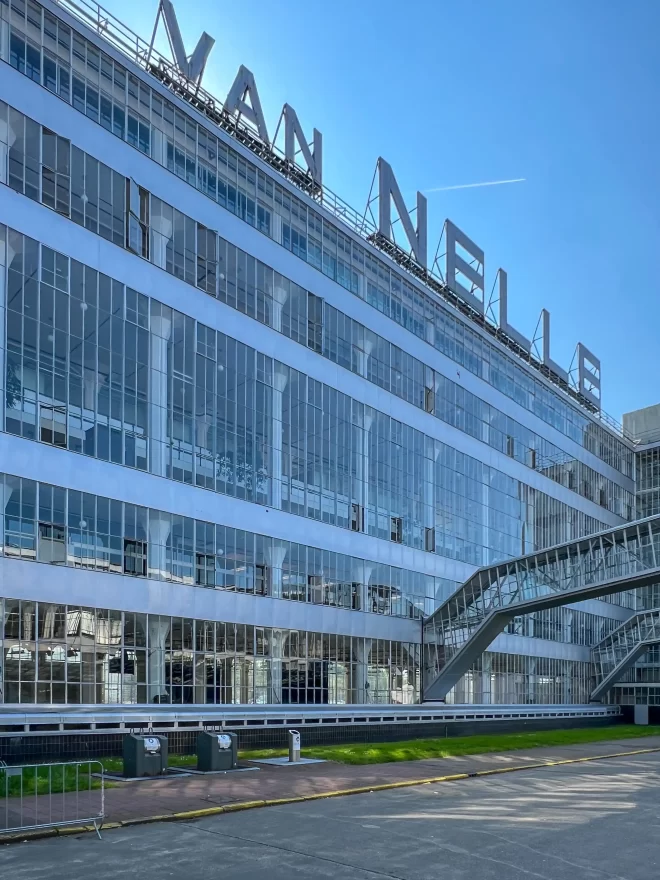
 Van-Nelle-Fabrik, 1925-1930. Architekt: Leendert van der Vlugt. Foto: Daniela Christmann
 1925 – 1930
Architect: Leendert van der Vlugt, Collaboration: Johannes Andreas Brinkman (civil engineer), Jan Gerko Wiebenga (civil engineer)
Van Nelleweg 1, Rotterdam, Netherlands
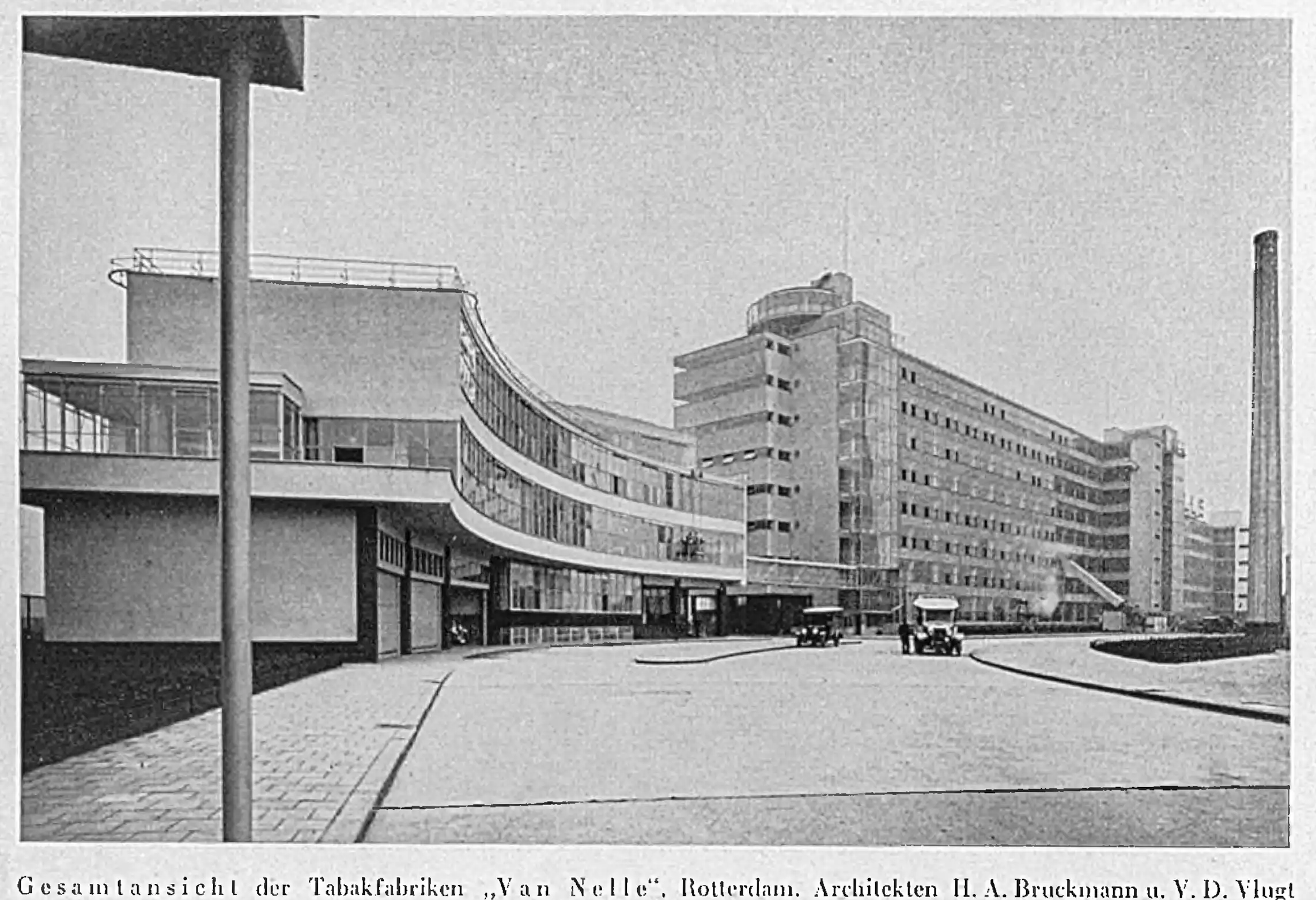
Van Nelle Factory, 1925-1930. Architect: Leendert van der Vlugt. Contemporary photo
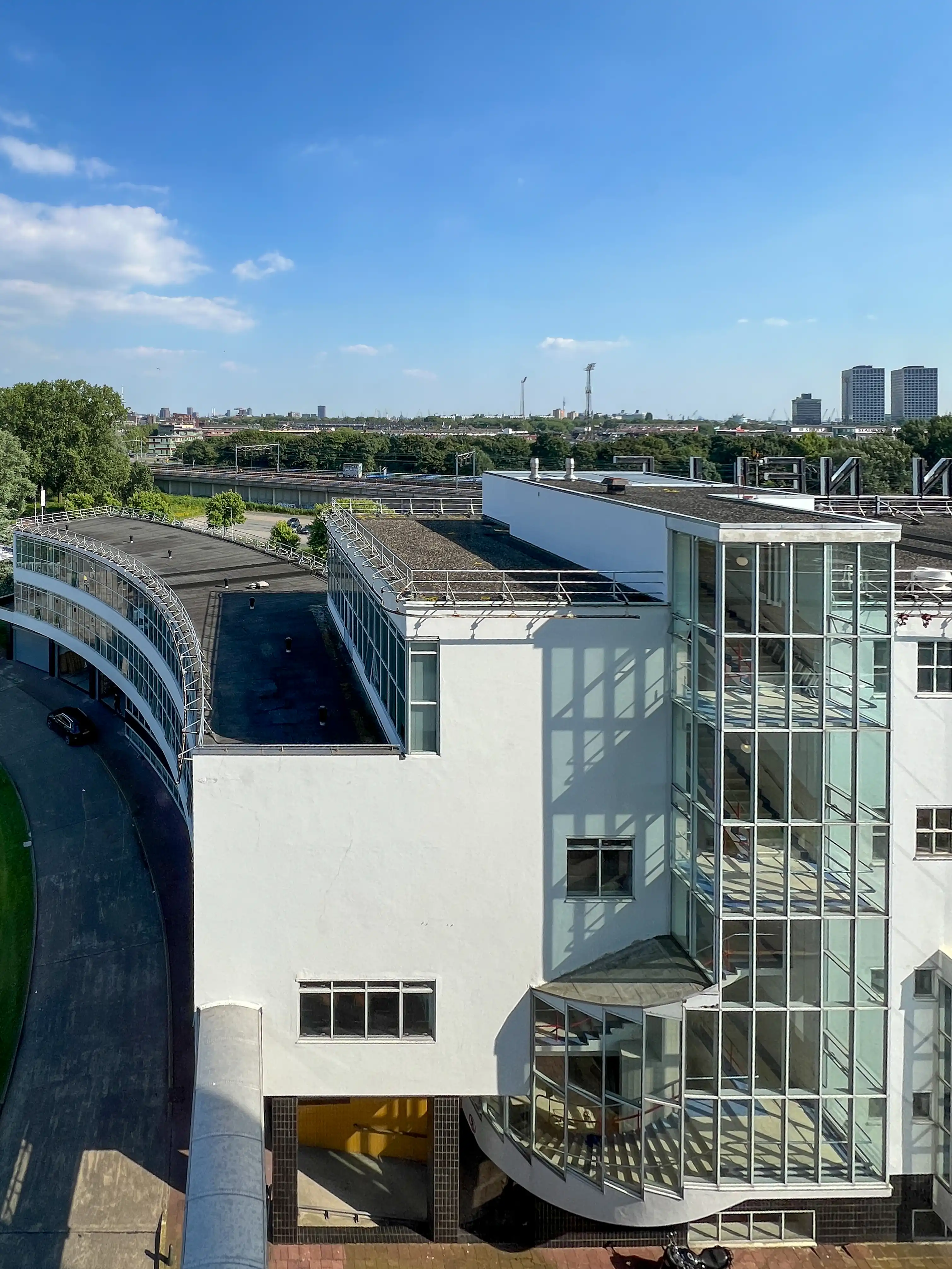
Van Nelle Factory, 1925-1930. Architect: Leendert van der Vlugt. Photo: Daniela Christmann
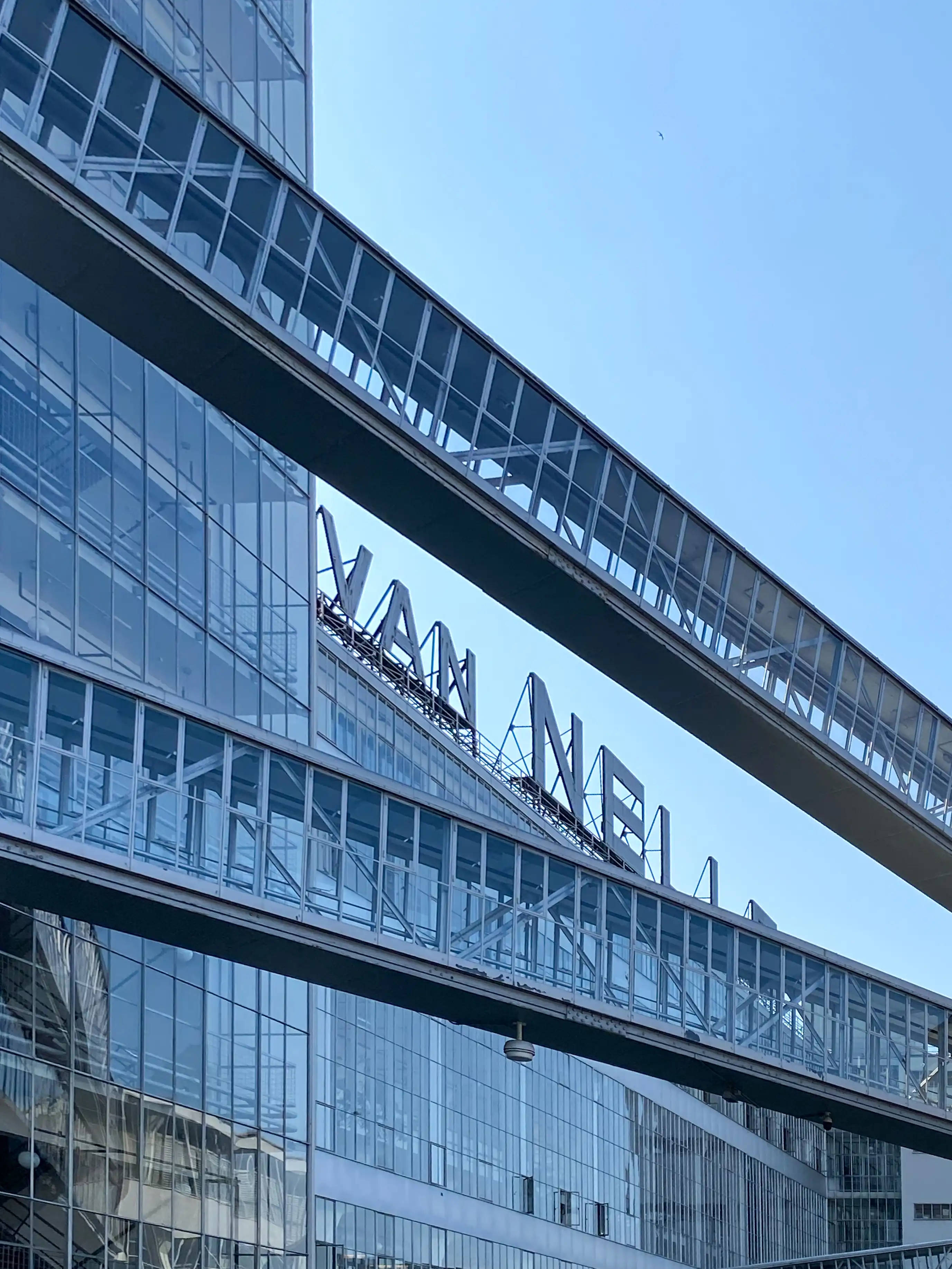
Van Nelle Factory, 1925-1930. Architect: Leendert van der Vlugt. Photo: Daniela Christmann
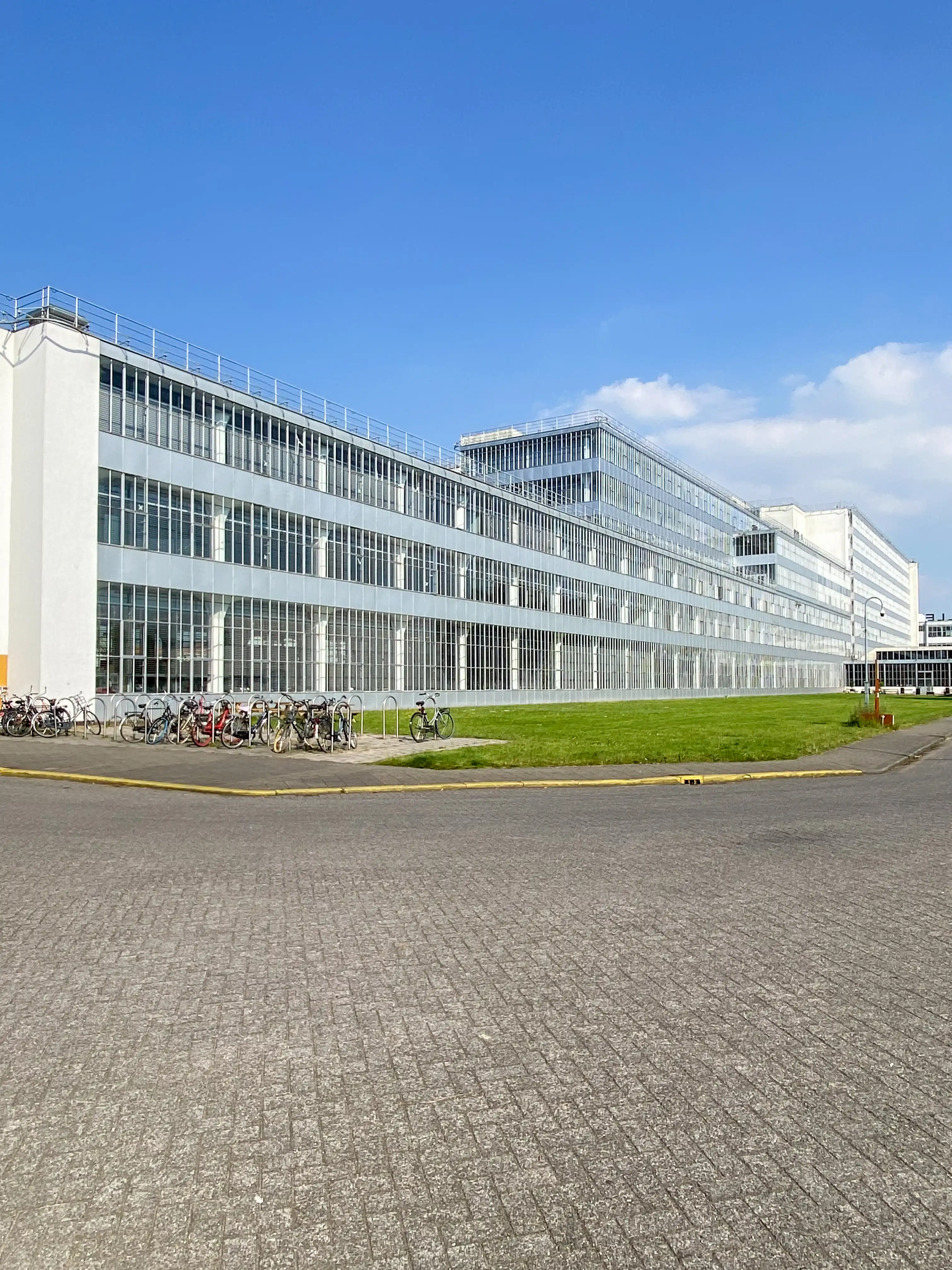
Van Nelle Factory, 1925-1930. Architect: Leendert van der Vlugt. Photo: Daniela Christmann
History
The building complex, constructed between 1925 and 1930 on the approximately 10-hectare factory site, was designed by architect Leendert van der Vlugt from the Brinkman & Van der Vlugt firm in collaboration with civil engineers Johannes Brinkman and Jan Gerko Wiebenga.
The factory complex is an example of the “Nieuwe Bouwen,” the Dutch variant of modern architecture.
Cees van der Leeuw, co-owner of the Van Nelle company, was the client. Impressed by Van der Vlugt’s skills, Van der Leeuw and the two managing directors, Matthijs de Bruyn and Albertus Hendrikus Sonneveld, commissioned him to design and build their private homes in Rotterdam (Huis Sonneveld) and nearby Schiedam between 1928 and 1932.
In the 20th century, the building housed a factory that processed coffee, tea, tobacco, chewing gum, cigarettes, instant pudding, and rice.
In 1989, Van Nelle was purchased by Sara Lee/Douwe Egberts, and the Van Nelle brand was transferred to Douwe Egberts Nederland. All Van Nelle production facilities closed in 1996. In 1998, the tobacco division of Douwe Egberts Van Nelle was acquired by the Imperial Tobacco Group.
Brinkman & Van der Vlugt
Michiel Brinkman established the architectural firm that would become Brinkman & Van der Vlugt when he founded his own practice in 1910. After his death, his son, Johannes Andreas — known as Jan Brinkman — continued his work, founding the partnership with Leendert van der Vlugt.
The creative partnership between Brinkman & Van der Vlugt was limited to the years 1925 to 1936, as Van der Vlugt passed away on April 25, 1936.
The firm’s designs range from industrial and office buildings to residential construction, spanning different building types.
Willem Kromhout
During his studies, Van der Vlugt was taught by Willem Kromhout, who, along with Hendrik Petrus Berlage, was responsible for the construction of significant buildings during that period. Kromhout was an inspiration in many ways, particularly in his approach to design. He believed that design and planning were never-ending processes of development.
Before teaming up with Jan Brinkman, Van der Vlugt worked in Kromhout’s office. “Van der Vlugt learned from Kromhout how to analyze the broad outline and details of a commission, how to balance these, and how to recognize the significance of details.” (Joris Molenaar, ” Voorbij een dor functionalisme: Woonhuis Sonneveld van Brinkman & Van der Vlugt (1929–1933).” (Archis, No. 8 [1993], p. 62).
The architects’ aspirations and approach greatly benefited from their acquaintance with the industrialist Cees van der Leeuw. He acted as their client, source of ideas, and intellectual discussion partner for over a decade. His influence was directly reflected in the results of their collaboration.
At that time, Van der Leeuw had set the personal goal of creating a factory environment that would allow employees to work there for their entire professional lives.
Mart Stam
From 1926 to 1928, Mart Stam was employed by the Brinkman en Van de Vlugt architectural firm. As a design draftsman, he worked on the Van Nelle Factory project. Stam had already encountered the Russian avant-garde in Berlin in 1922.
Russian constructivism particularly influenced the large letters on the Van Nelle factory’s roofs.
During his first year at Brinkman & Van der Vlugt in 1926, he organized an architectural tour of the Netherlands for the Russian artist El Lissitzky and his wife, Sophie Küppers, a contemporary art collector. They visited several architects, including Jacobus Oud, Gerrit Rietveld, and Cornelis van Eesteren. According to Küppers, Stam talked about “his” factory during the trip.
Stam’s influence is most evident in the buildings’ austere and functional character. Stam rejected the rounded shape of the office building and the so-called bonbonniere on the roof.
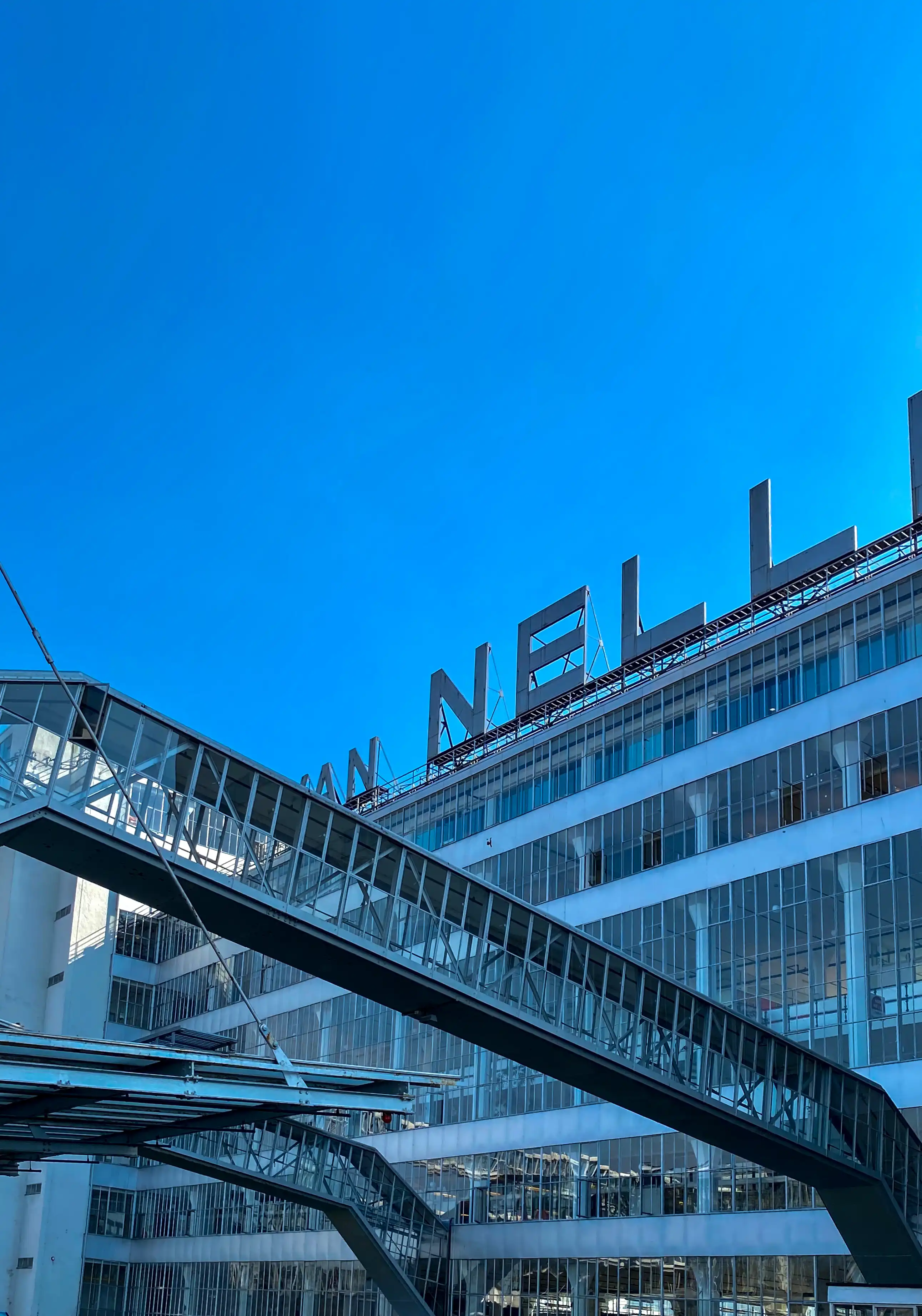
Van Nelle Factory, 1925-1930. Architect: Leendert van der Vlugt. Photo: Daniela Christmann
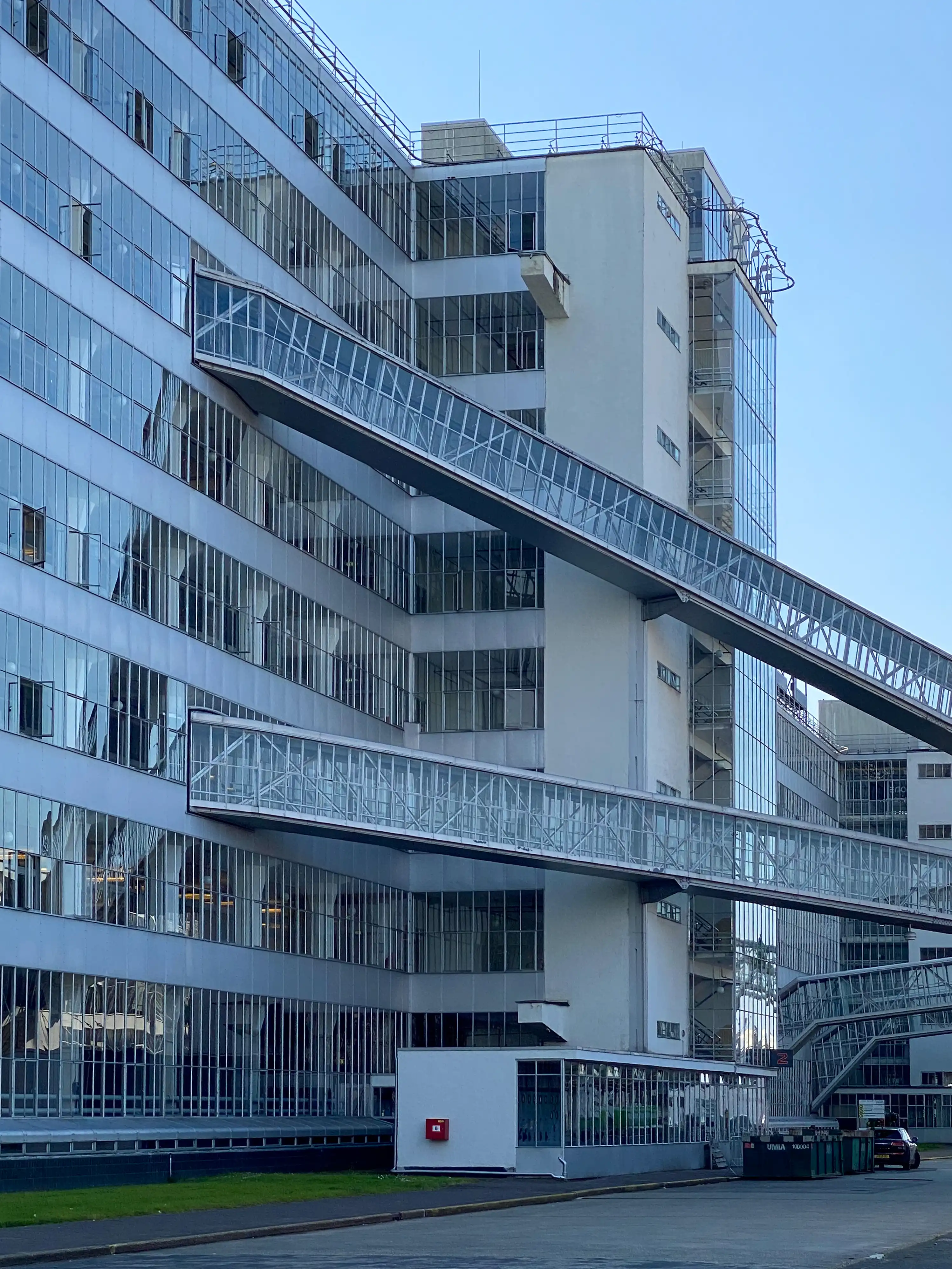
Van Nelle Factory, 1925-1930. Architect: Leendert van der Vlugt. Photo: Daniela Christmann
Van Nelle Tobacco, Coffee, and Tea Factory
The Van Nelle Factory was built between 1926 and 1931 in the polder area on Schuttevaerweg in Schiedam. It is located on the Maas River between Schuttevaerweg and the Delfshavense Schie waterway. As early as 1918, Michiel Brinkman was commissioned to find a suitable location for the factory and coordinate it with the Rotterdam city administration.
The ability to implement expansive plans in the long term was a particularly convincing factor in choosing the location.
However, the location in the Spaanse Polder posed challenges in preparing the building site. This posed a major challenge for Jan Brinkman, who took over the construction project from his father, Michiel, in 1925. He developed a new method to stabilize the land for construction.
Sand was pumped from the port of Rotterdam using suction dredgers to accomplish this. The sand was transported via long pipelines to the construction site, where it flowed into individual polder sections separated by small dikes.
This raised the terrain. However, before construction could begin, the sand and peat layers had to settle and solidify.
For the production building’s foundation, Brinkman & Van der Vlugt drew on engineer Jan Gerko Wiebenga’s experience working in America. He founded the building with reinforced concrete supports.
Building Structures
When viewed from the eastern entrance to the site, the complex consists of several buildings, as follows: on the left is the two-story arched office building, followed by the production area, which consists of several sections.
Across from it is the two-story logistics building, which stands directly on the banks of the Maas, an important river for Rotterdam’s trade and shipping.
The sloping transport bridges between the production area and the logistics building are also noteworthy. They have become a striking feature in pictorial publications of the Van Nelle Factory.
The factory’s production area extends as an elongated building block.
Above the foundations, the structure consists of reinforced concrete columns and a curtain wall.
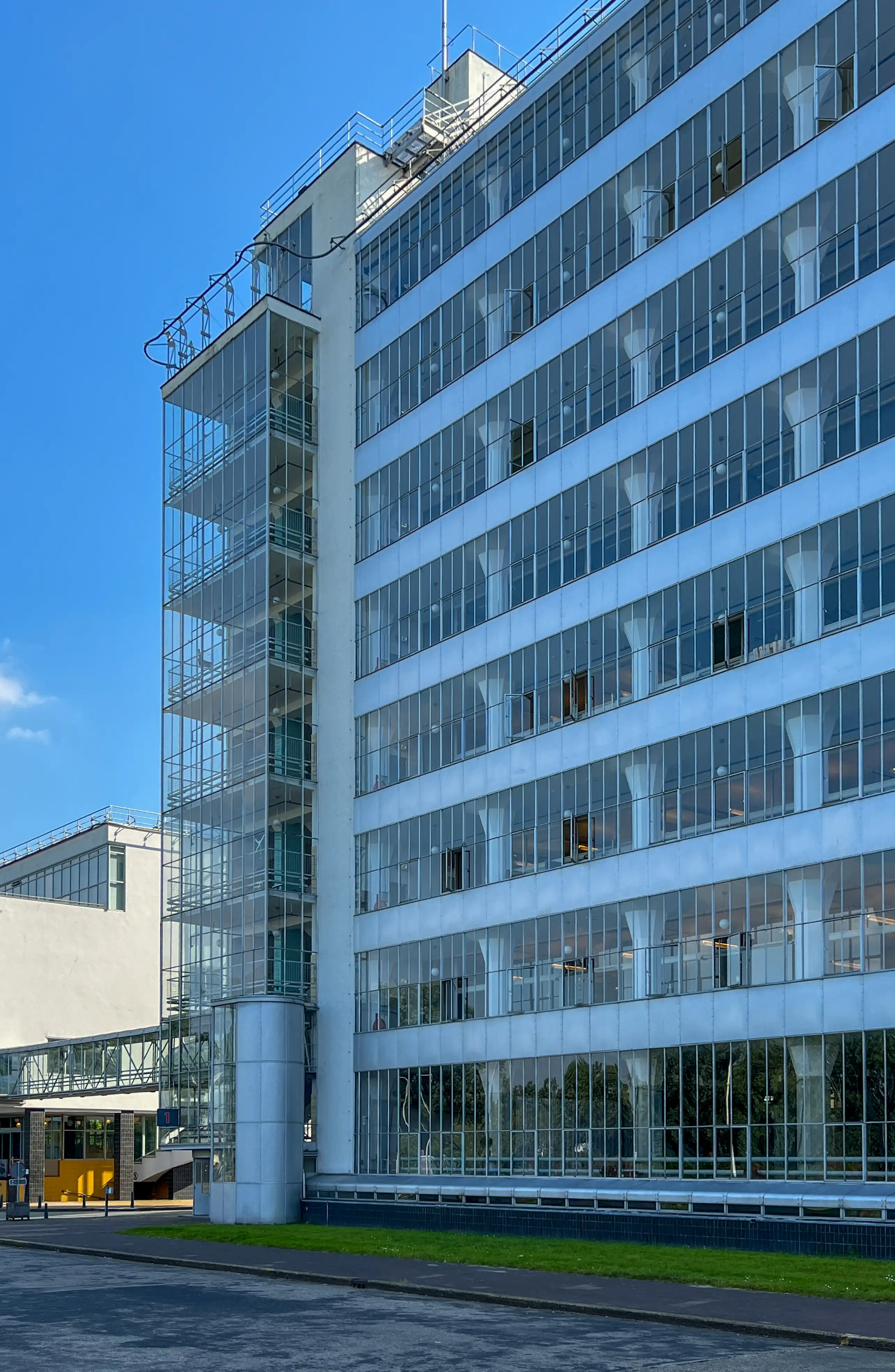
Van Nelle Factory, 1925-1930. Architect: Leendert van der Vlugt. Photo: Daniela Christmann
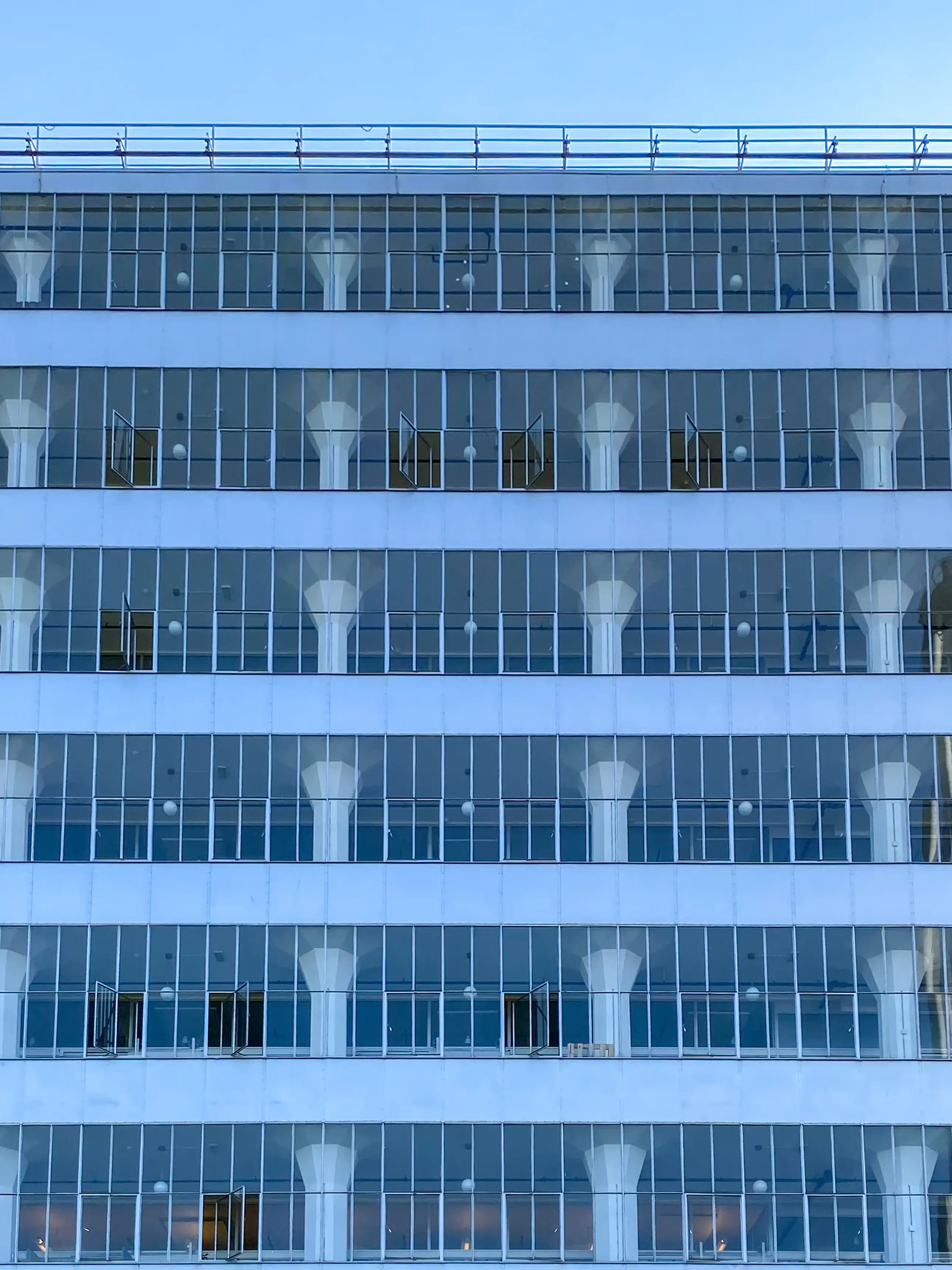
Van Nelle Factory, 1925-1930. Architect: Leendert van der Vlugt. Photo: Daniela Christmann
Factory
The factory consists of three buildings of varying heights. There is an eight-story building for tobacco, a five-story building for coffee with a mezzanine that is twice as high, and a three-story building for tea. The intermediate buildings connecting these areas contain stairs, toilets, washrooms, and elevators.
Each stair tower has a unique shape. At the rear of the tobacco area, there is a warehouse with a gabled roof. All three areas border a main supply route and are connected by the factory’s trademark bridges to shipping and storage rooms, a bicycle shelter, a boiler room, and workshops.
The factory’s concrete floor slabs are supported by mushroom-shaped concrete columns, which make the façades self-supporting. This is emphasized by continuous bands of windows that flood the work areas with daylight.
The Bonbonniere is the name given to the round tea room on top of the Van Nelle factory. It was once used to welcome honored guests.
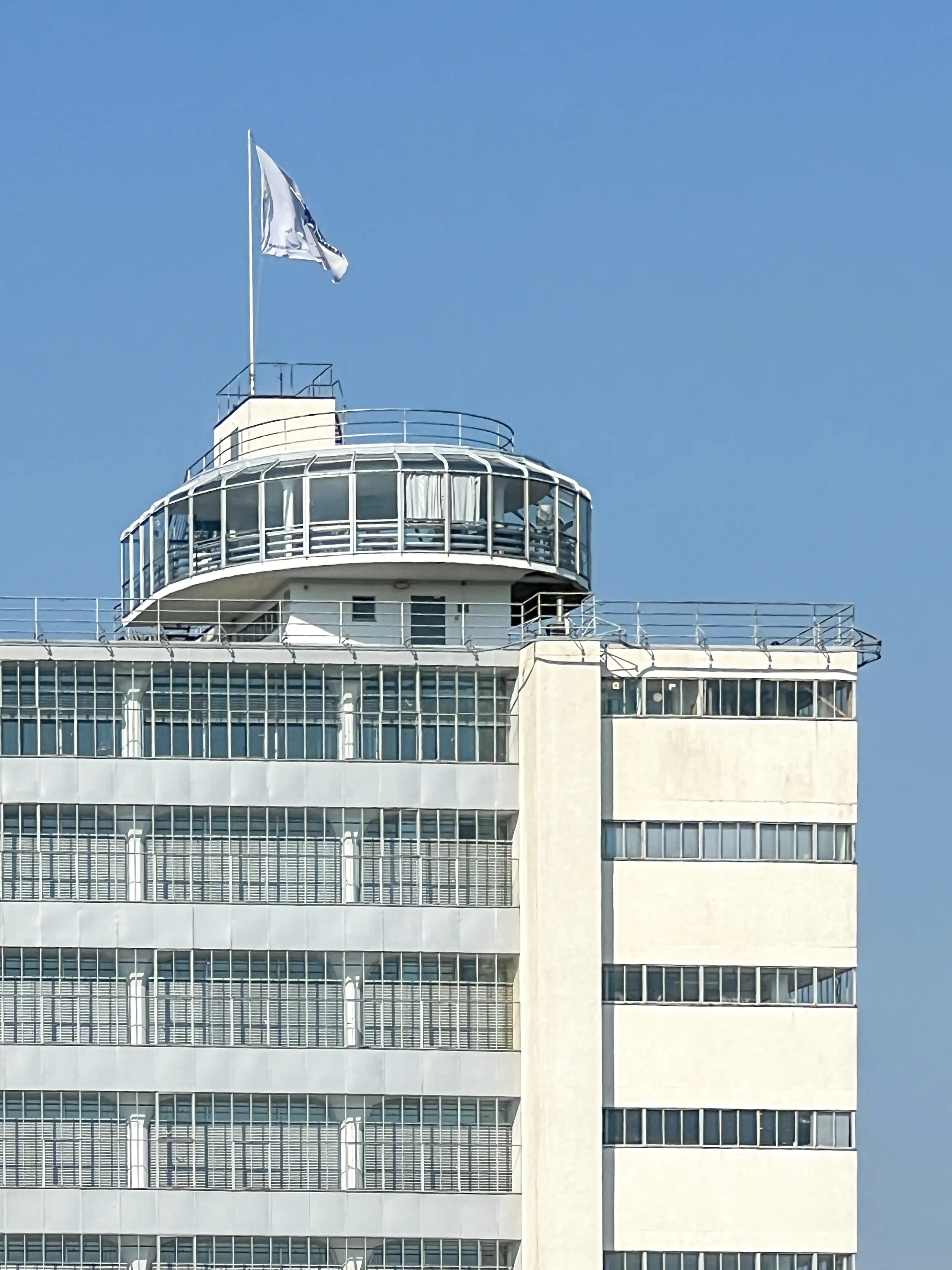
Van Nelle Factory, 1925-1930. Architect: Leendert van der Vlugt. Photo: Daniela Christmann
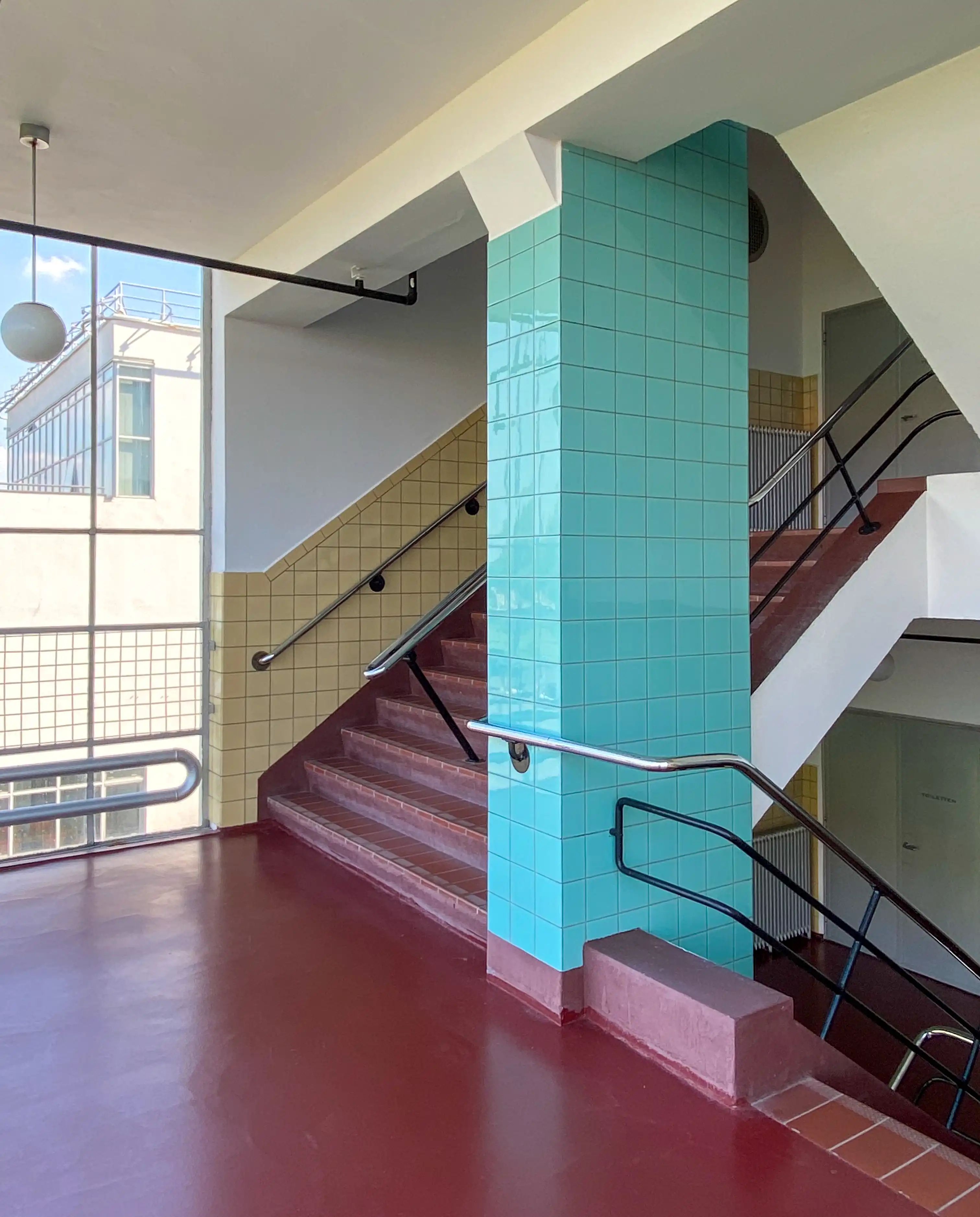
Van Nelle Factory, 1925-1930. Architect: Leendert van der Vlugt. Photo: Daniela Christmann
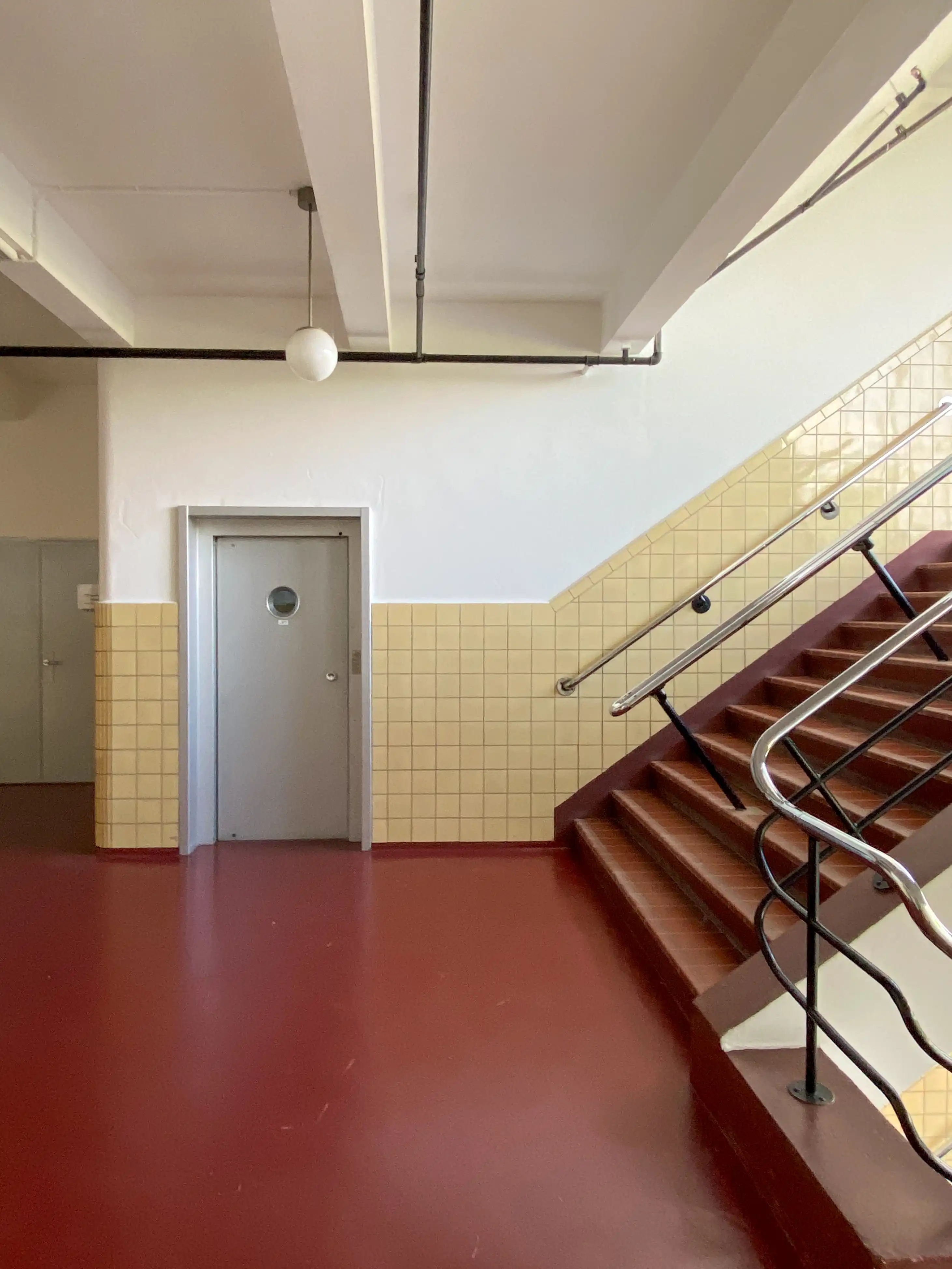
Van Nelle Factory, 1925-1930. Architect: Leendert van der Vlugt. Photo: Daniela Christmann
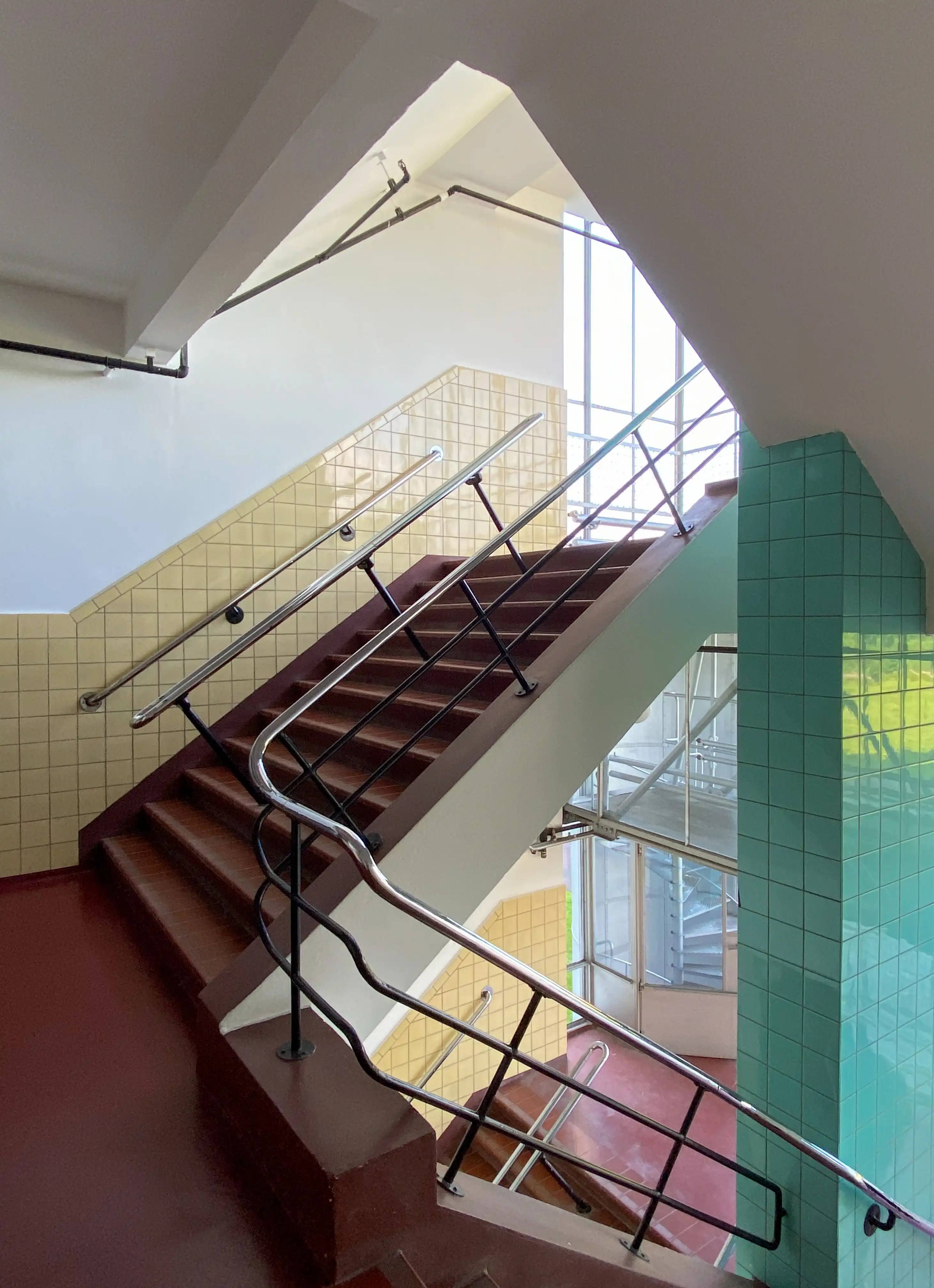
Van Nelle Factory, 1925-1930. Architect: Leendert van der Vlugt. Photo: Daniela Christmann
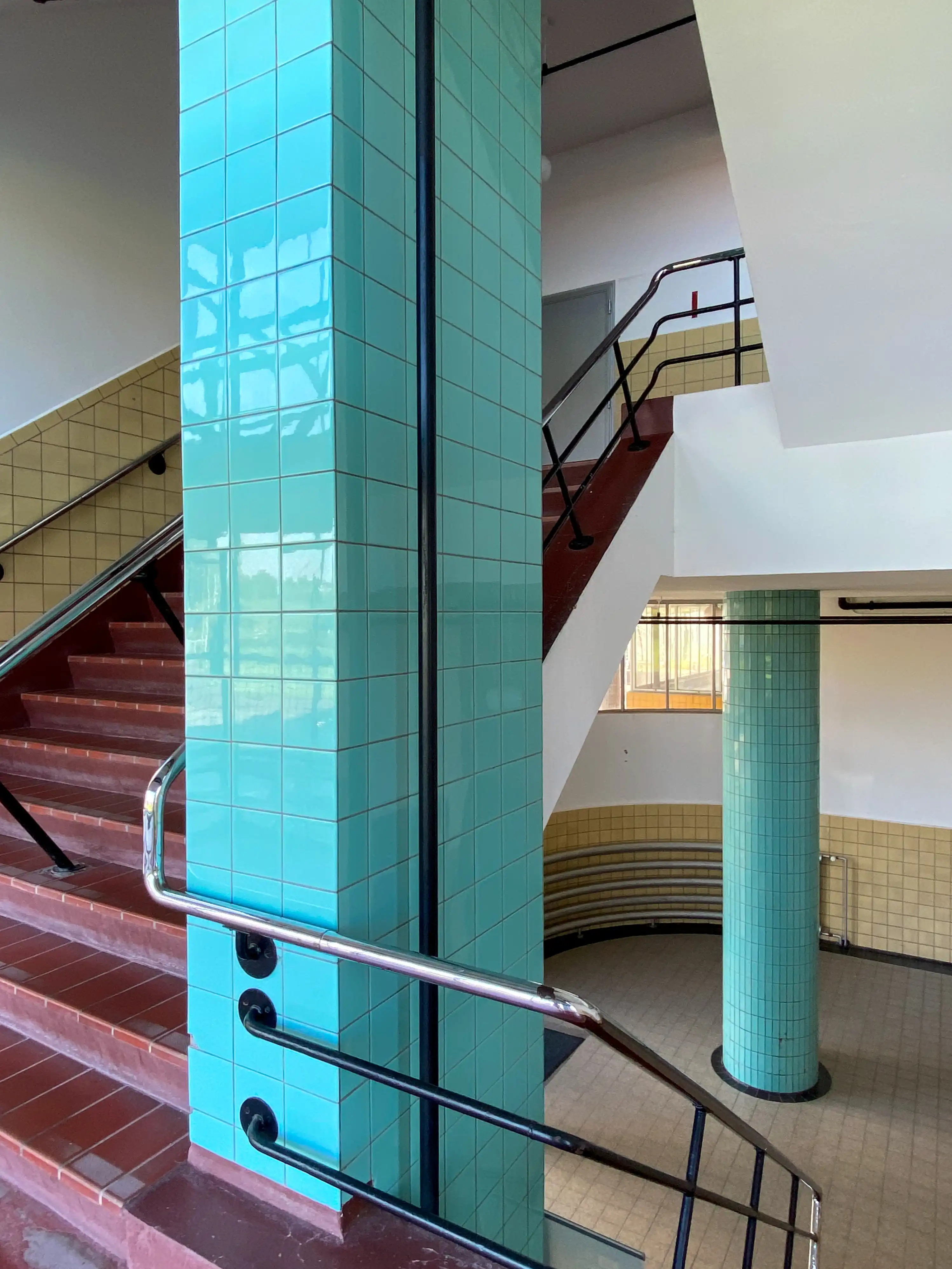
Van Nelle Factory, 1925-1930. Architect: Leendert van der Vlugt. Photo: Daniela Christmann
Interior Spaces
The furniture and lighting were provided by the Dutch company, Gispen. A limited color palette was used for both the exterior and interior. White tones dominate, while aluminum colors, chrome, and shades of red, yellow, blue, gray, and black provide bold accents.
The furnishings of the bright rooms are characterized by a strict, functionalist aesthetic with originally flat floors featuring linoleum, wood, granite, or tile surfaces; wall coverings; tubular steel furniture; colored glass window sills and countertops; and round ceiling lights. The predominantly rectangular shapes are broken up by curves in prominent places.
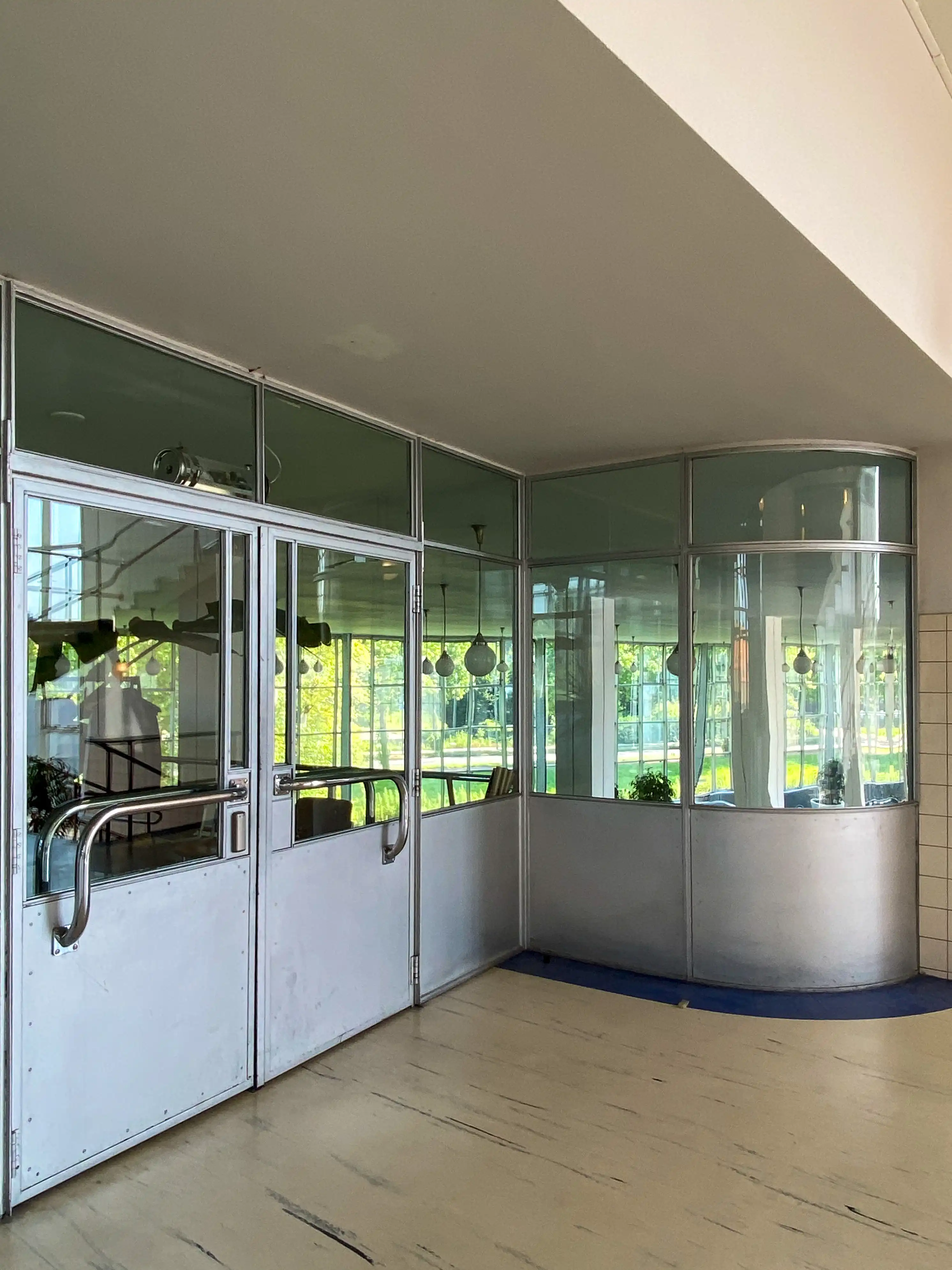
Van Nelle Factory, 1925-1930. Architect: Leendert van der Vlugt. Photo: Daniela Christmann
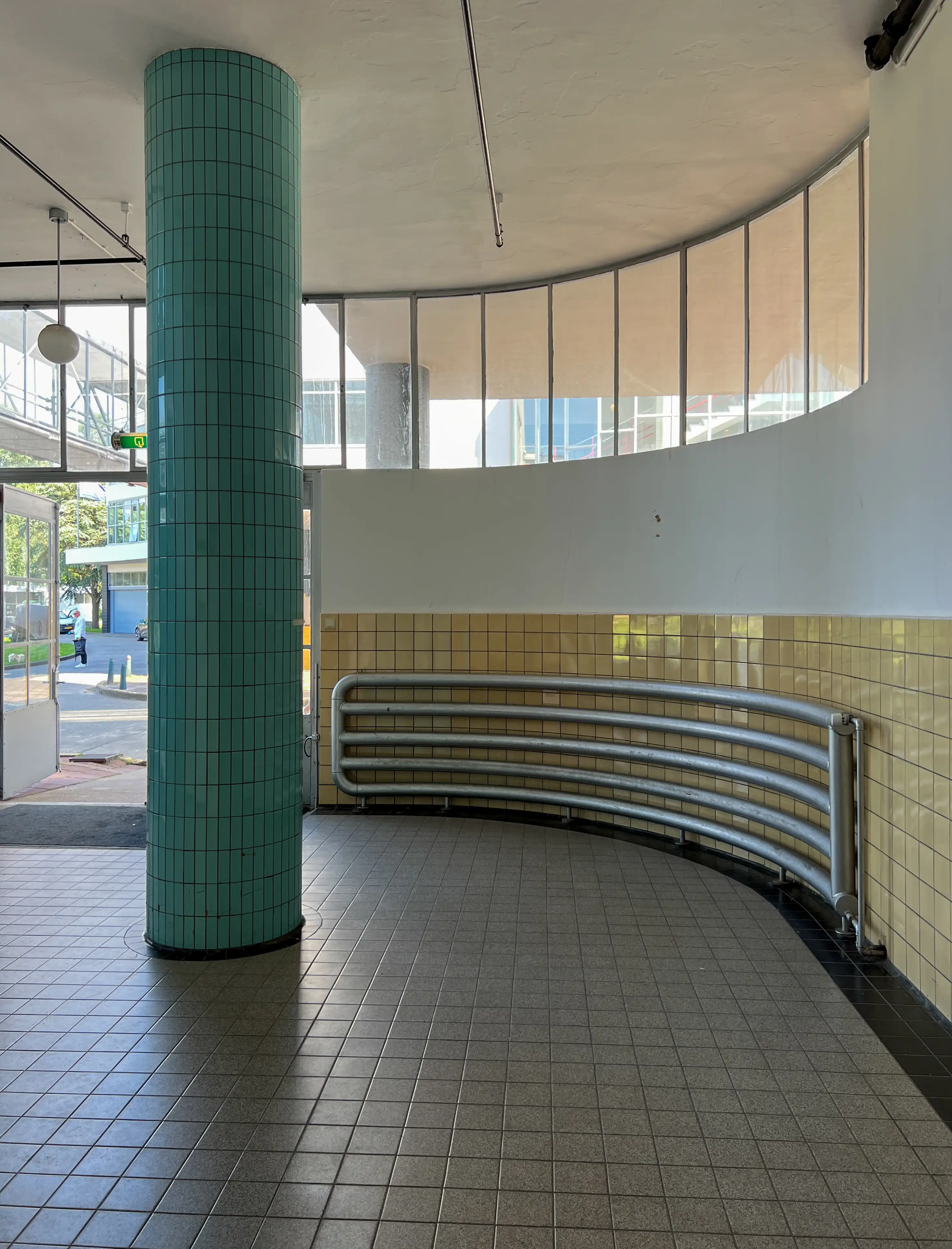
Van Nelle Factory, 1925-1930. Architect: Leendert van der Vlugt. Photo: Daniela Christmann
Office Building
A freestanding office building marks the entrance to the site, and its façade follows the curve of the access road.
This building houses the management offices. The remaining rooms are arranged in a row perpendicular to the access road. A double-height open-plan office area with glass partitions and cubicles connects the two parts of the building.
It is these very elements, designed by Van der Vlugt, that give this functionalist masterpiece its architectural quality. The combination of functionalism and a humanistic approach to architecture—an approach Van der Vlugt shared with Jan Duiker—represents a high point in Dutch modernism.
Van Nelle Factory, 1925-1930. Architect: Leendert van der Vlugt. Photo: Daniela Christmann
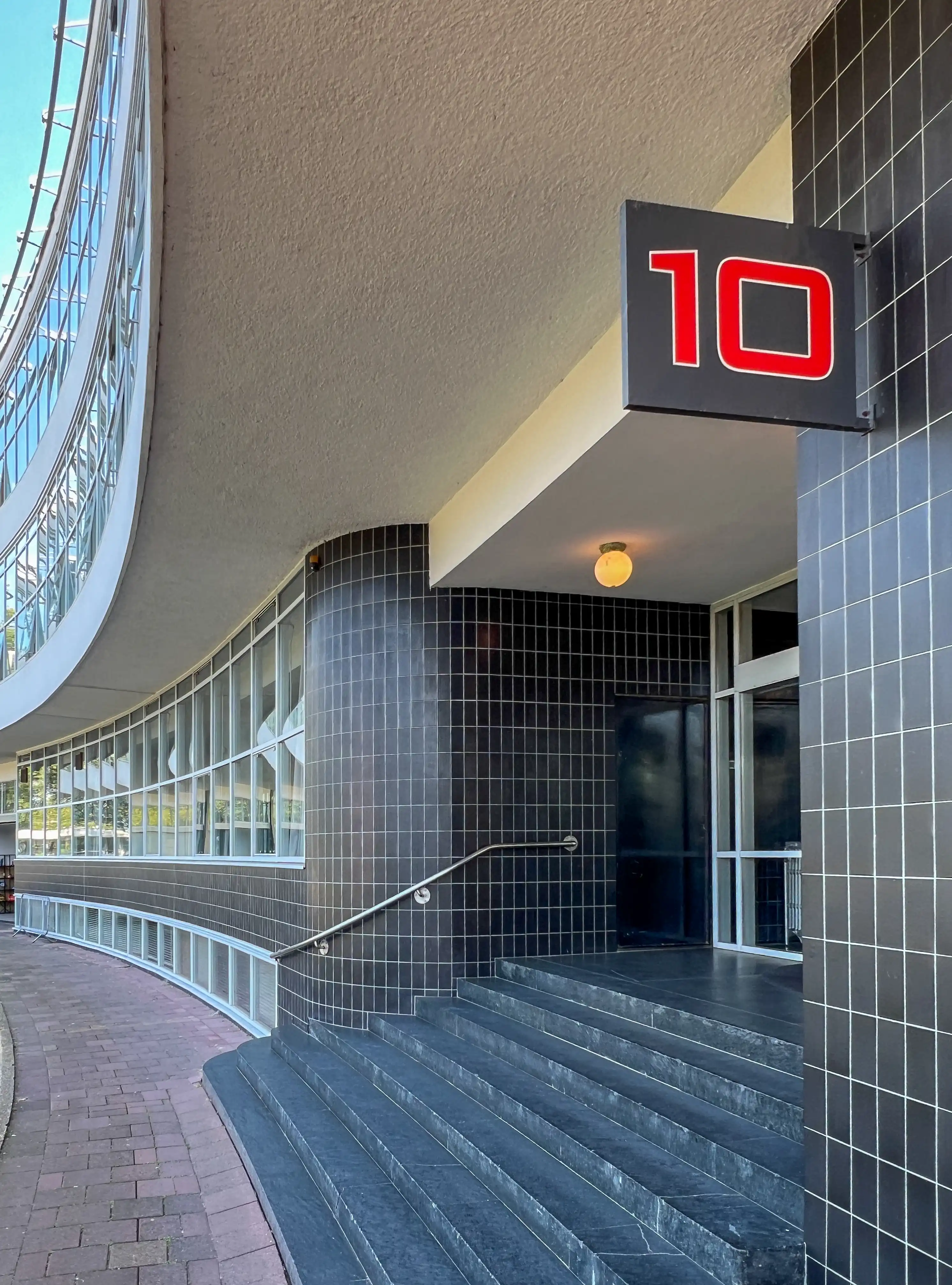
Van Nelle Factory, 1925-1930. Architect: Leendert van der Vlugt. Photo: Daniela Christmann
UNESCO World Heritage Site
The complex was listed as a national monument in 1986 and became a UNESCO World Heritage Site on June 21, 2014.
After Van Nelle moved out, the factory buildings were renovated between 1998 and 2004 and again between 2000 and 2006. Today, they house a so-called “design factory.”
The outbuildings and boiler house were also renovated and now house offices for architectural firms and a branch of the Netherlands Architecture Institute.
The finely detailed original gatehouse and functional-style entrance gates were replaced in 1982 by the current non-listed structures.
In 1991, the southeasternmost workshop wings were demolished to make way for a coffee silo designed by M. Booy of the architectural firm Van den Broek en Bakema.