
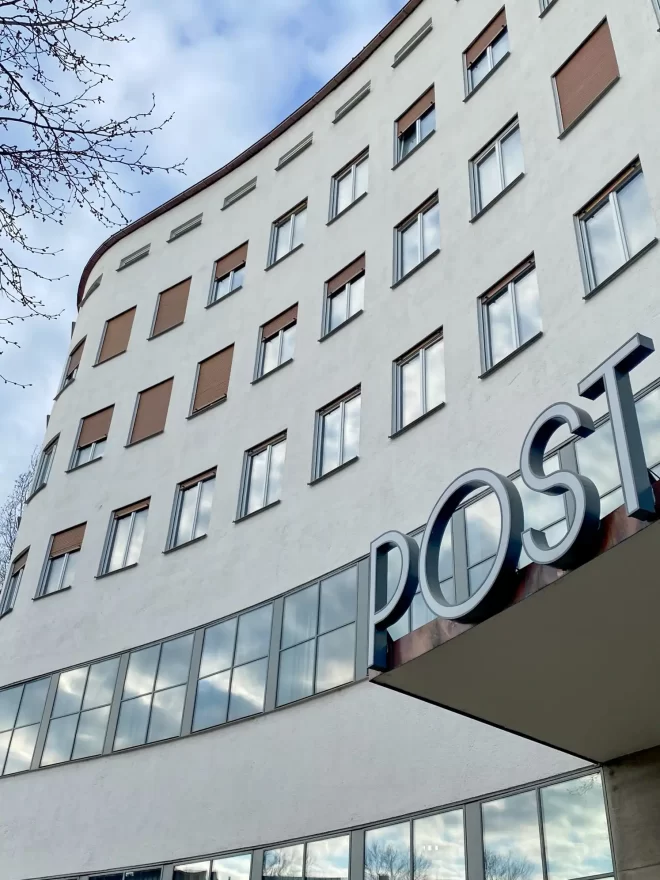
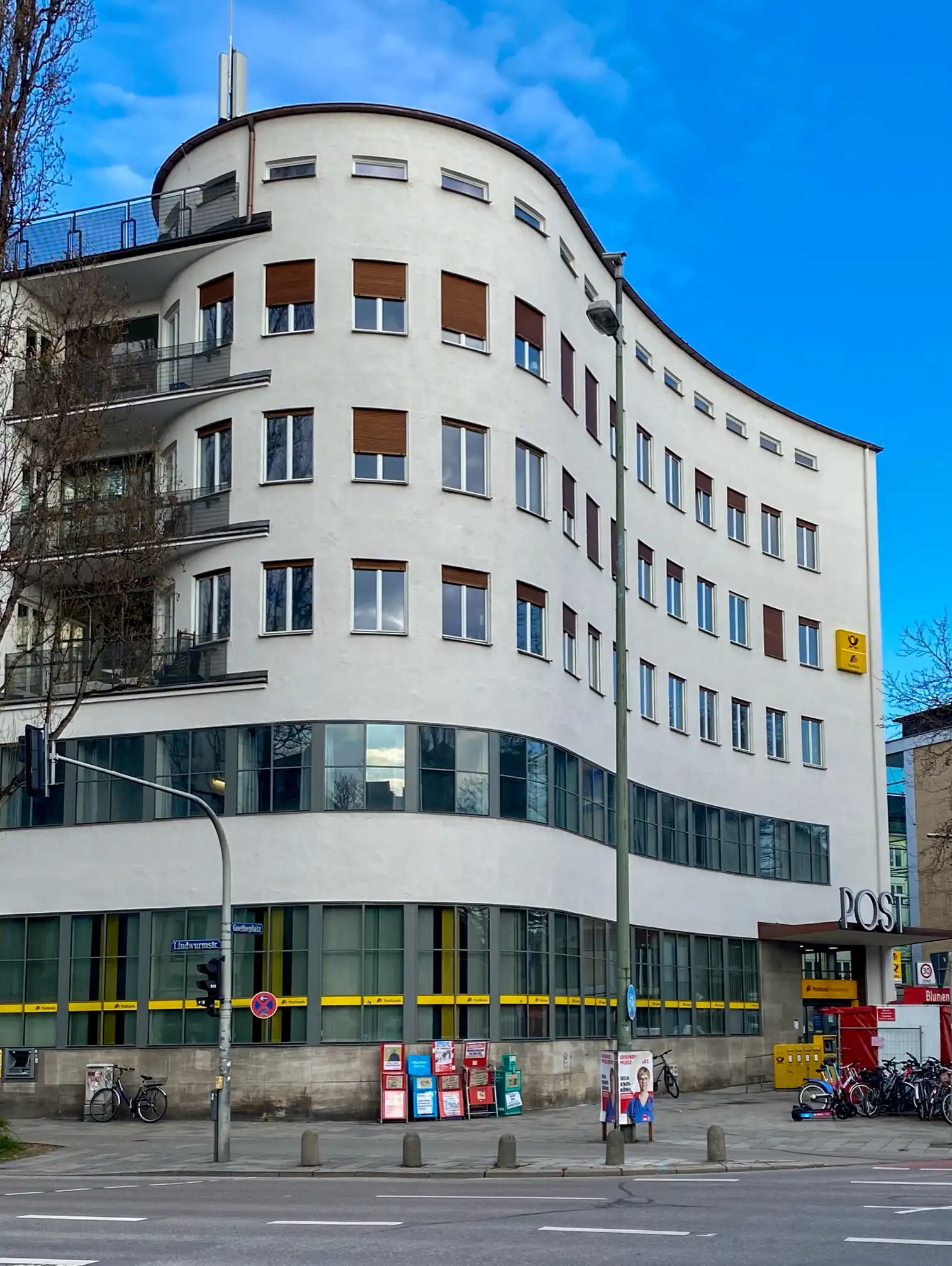
Postoffice Goetheplatz, 1931-1932. Architects: Franz Holzhammer, Walther Schmidt. Photo: Daniela Christmann
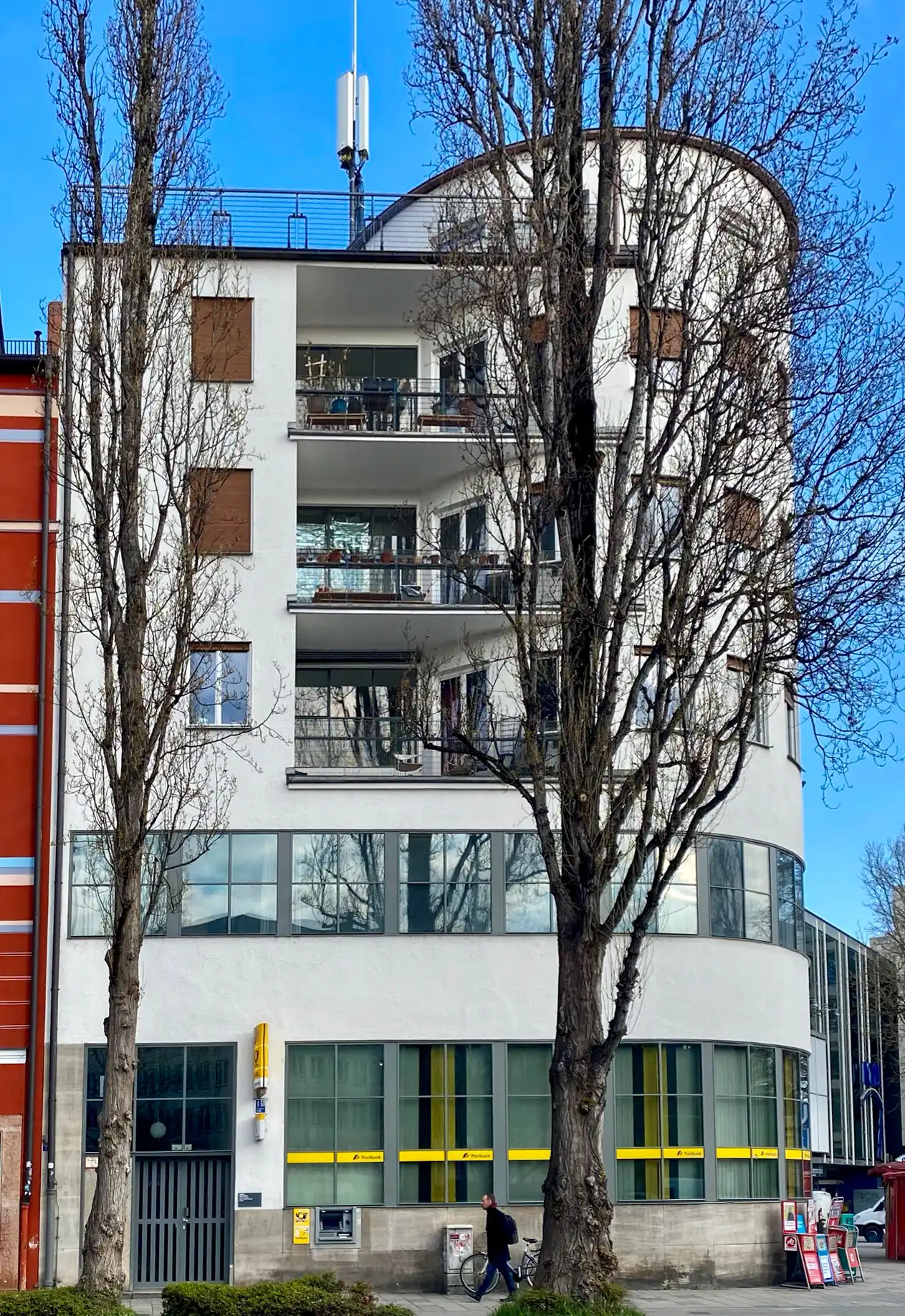
Postoffice Goetheplatz, 1931-1932. Architects: Franz Holzhammer, Walther Schmidt. Photo: Daniela Christmann
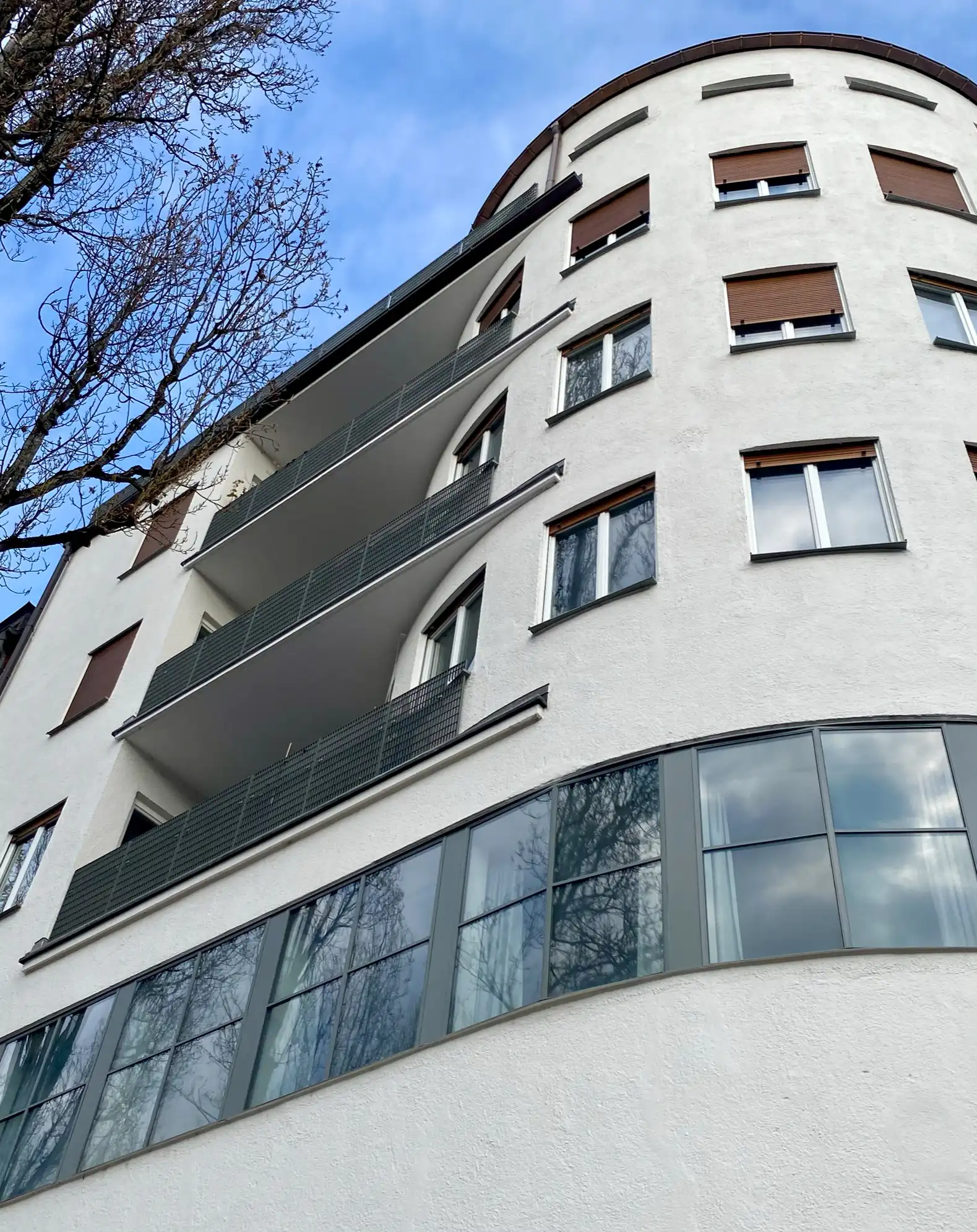
Postoffice Goetheplatz, 1931-1932. Architects: Franz Holzhammer, Walther Schmidt. Photo: Daniela Christmann
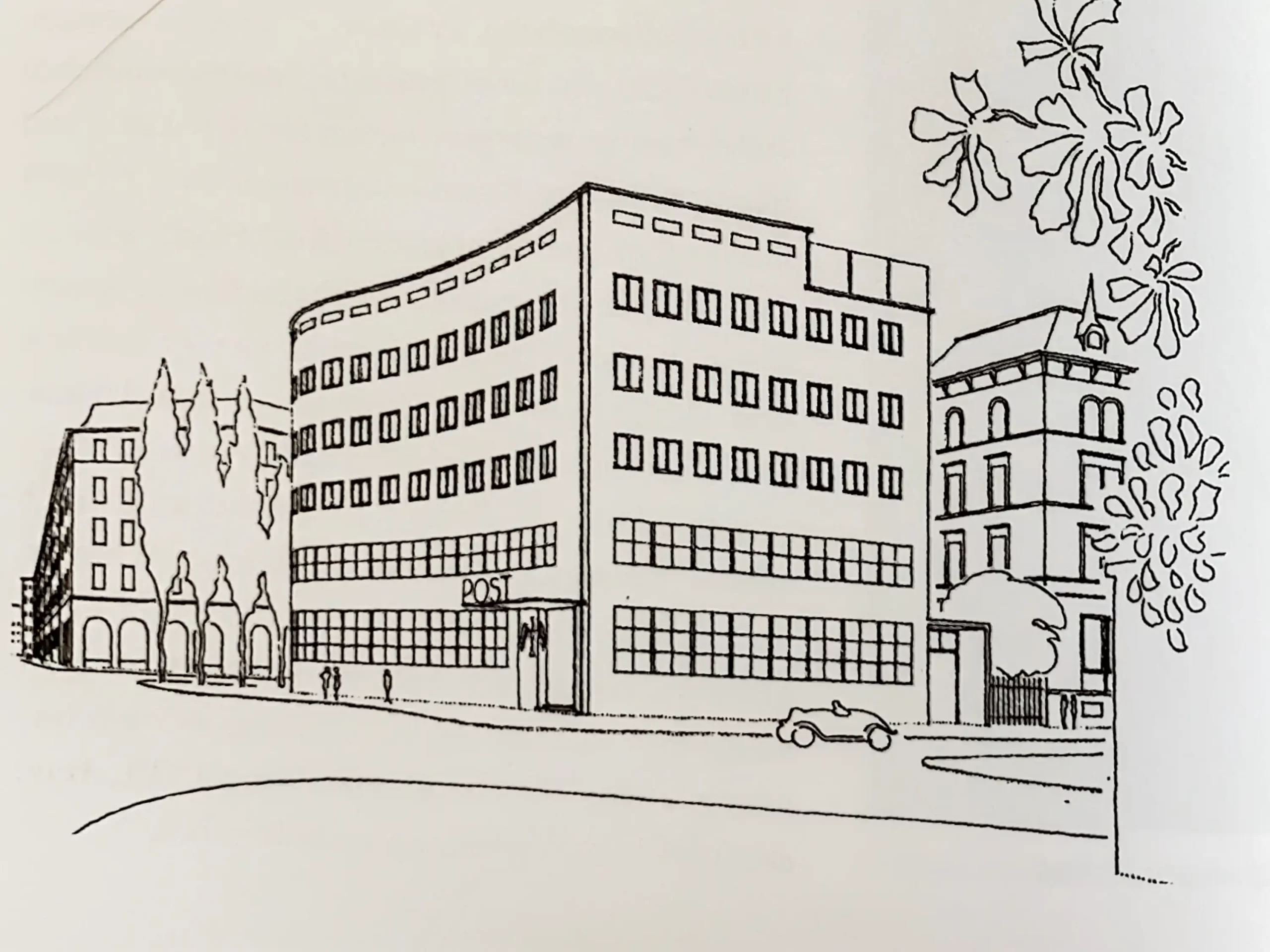
Postoffice Goetheplatz, 1931-1932. Architects: Franz Holzhammer, Walther Schmidt. Design sketch
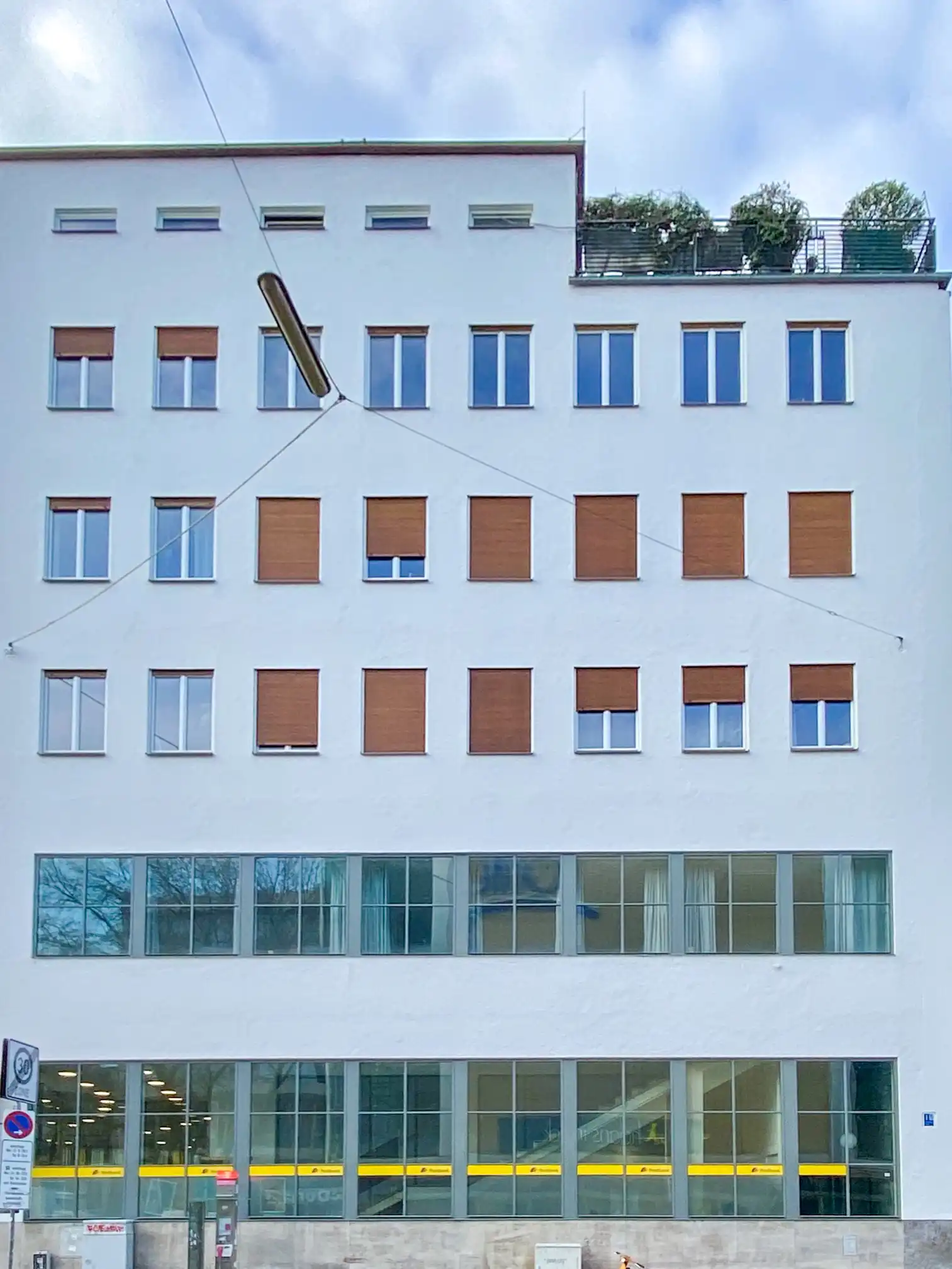
Postoffice Goetheplatz, 1931-1932. Architects: Franz Holzhammer, Walther Schmidt. Photo: Daniela Christmann
1931 – 1932
Architects: Franz Holzhammer, Walther Schmidt
Goetheplatz 1, Lindwurmstraße 6, Munich, Germany
The five-story post office building, which features a curved facade structured by an elongated window band and uniform rows of windows, as well as a glazed first floor, was constructed on Goetheplatz in Munich from 1931 to 1932. The building was designed by architects Franz Holzhammer and Walther Schmidt. It is a prime example of the architecture of the Bavarian Postal School.
Bavarian Postal Architecture School
From 1920 to 1934, the Bavarian Postal Architecture School was the defining example of the “New Building” movement in Bavaria. Robert Poeverlein and, more notably, Robert Vorhoelzer are considered the founders of the school. The school was named after the Munich postal buildings on Tegernseer Platz and Goetheplatz. Key representatives included Walther Schmidt, Hanna Löv, and Sep Ruf.
Despite the transition from the Bavarian State Postal Service to the German Reichspost in Berlin, the Postal State Treaty of 1920 established a separate department of the Reich Postal Ministry in Munich as a symbol of independence: Department VI.
Within this division, an independent postal architecture department was established. Numerous forward-thinking architects, including Poeverlein and Vorhoelzer, took advantage of the creative freedom this department offered to design buildings in the “Neues Bauen” style.
Until the National Socialists seized power in 1933, the School of Postal Architecture shaped the entire field of postal architecture in Bavaria. This was driven primarily by the increased demand for postal service buildings. Between 1920 and 1935, approximately 350 buildings were constructed in villages and small towns.
Also worth noting is the experimental housing complex on Arnulfstraße in Munich, where the “Munich kitchen” was developed. This functional kitchen has an open passageway to the dining room and a largely glass-enclosed wall. It was designed to reduce the isolation of women in the kitchen.
Neue Sachlichkeit
Constructed in the styles of Neue Sachlichkeit (New Objectivity) and Classical Modernism, the building has a reinforced concrete skeleton and is lined with pumice stone.
The post office construction site on Goetheplatz was bounded by Lindwurmstraße and Mozartstraße, forming an acute-angled corner. Delivery and loading activities were carried out from the courtyard entrance on Mozartstrasse.
Post Office and Apartments
The listed building houses a post office on the ground floor and apartments on the upper floors.
When the building was constructed, the parcel sorting department was located on the ground floor, and the letter carrier’s room was located on the first floor.
Both were accessed by a common staircase, like the apartments above.
Rooms of the postal administration, as well as additional apartments for postal employees, were accessed via a staircase on Lindwurmstrasse. The staircase between the first and second floors of this staircase was shifted to the center of the building by a 90-degree turn.
Counter Hall
The ground-floor counter hall was accessed via a vestibule from Goetheplatz.
The vestibule contained the Silent Post Office, which had telephone booths, mailboxes, and post office boxes.
Light fell into the counter rooms from two directions: the curved glazed façade and a narrow band of windows on the courtyard side.
Apartements
The upper-floor apartments were spacious, with long hallways and plank floors. The kitchens and bathrooms faced the courtyard, and the bedrooms and living rooms faced the street.
The end of the building featured an attic with a janitor’s apartment and a drying loft, as well as a roof terrace for residents and postal employees.
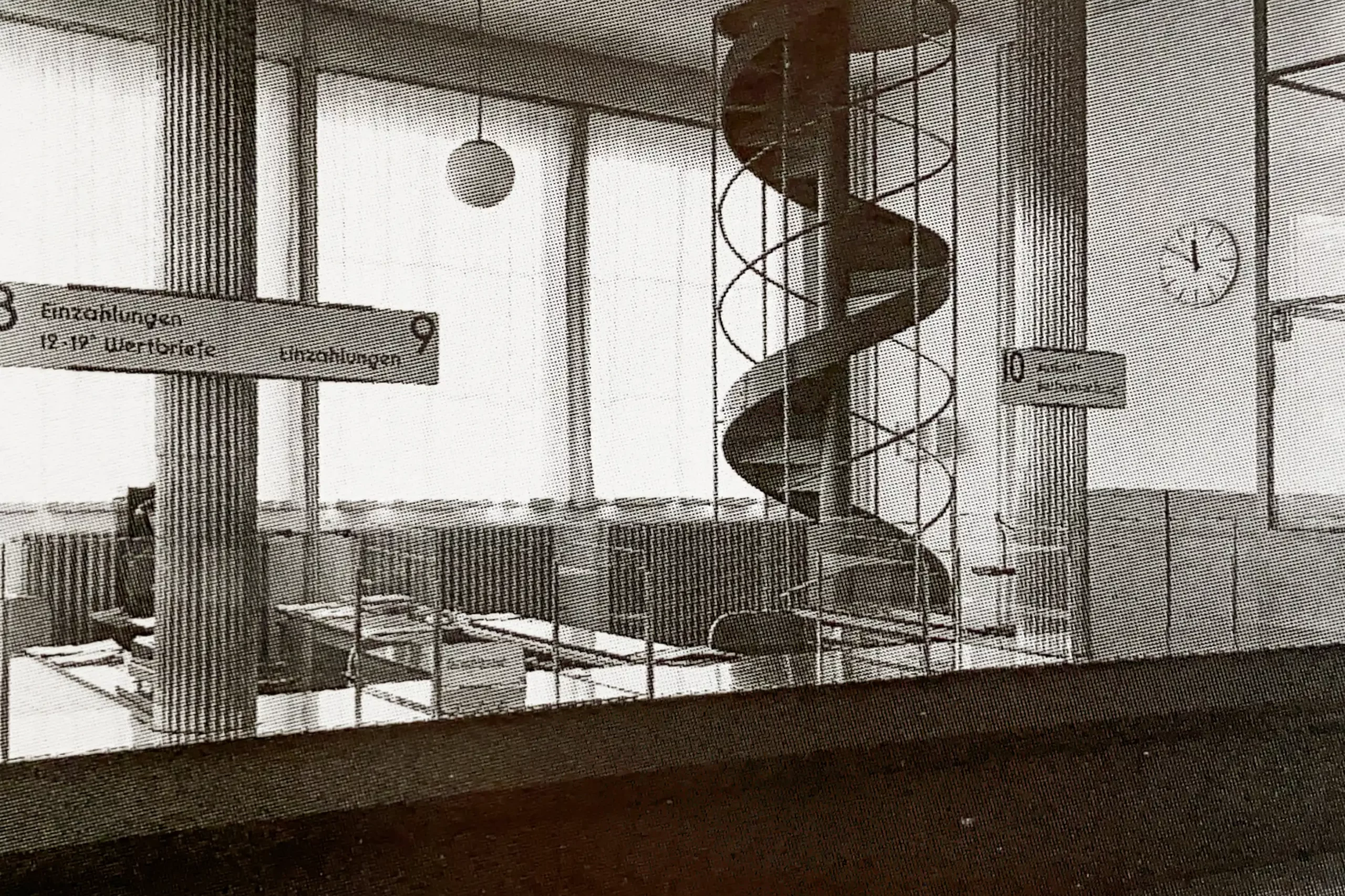
Postoffice Goetheplatz, 1931-1932. Architects: Franz Holzhammer, Walther Schmidt. Contemporary interior photo
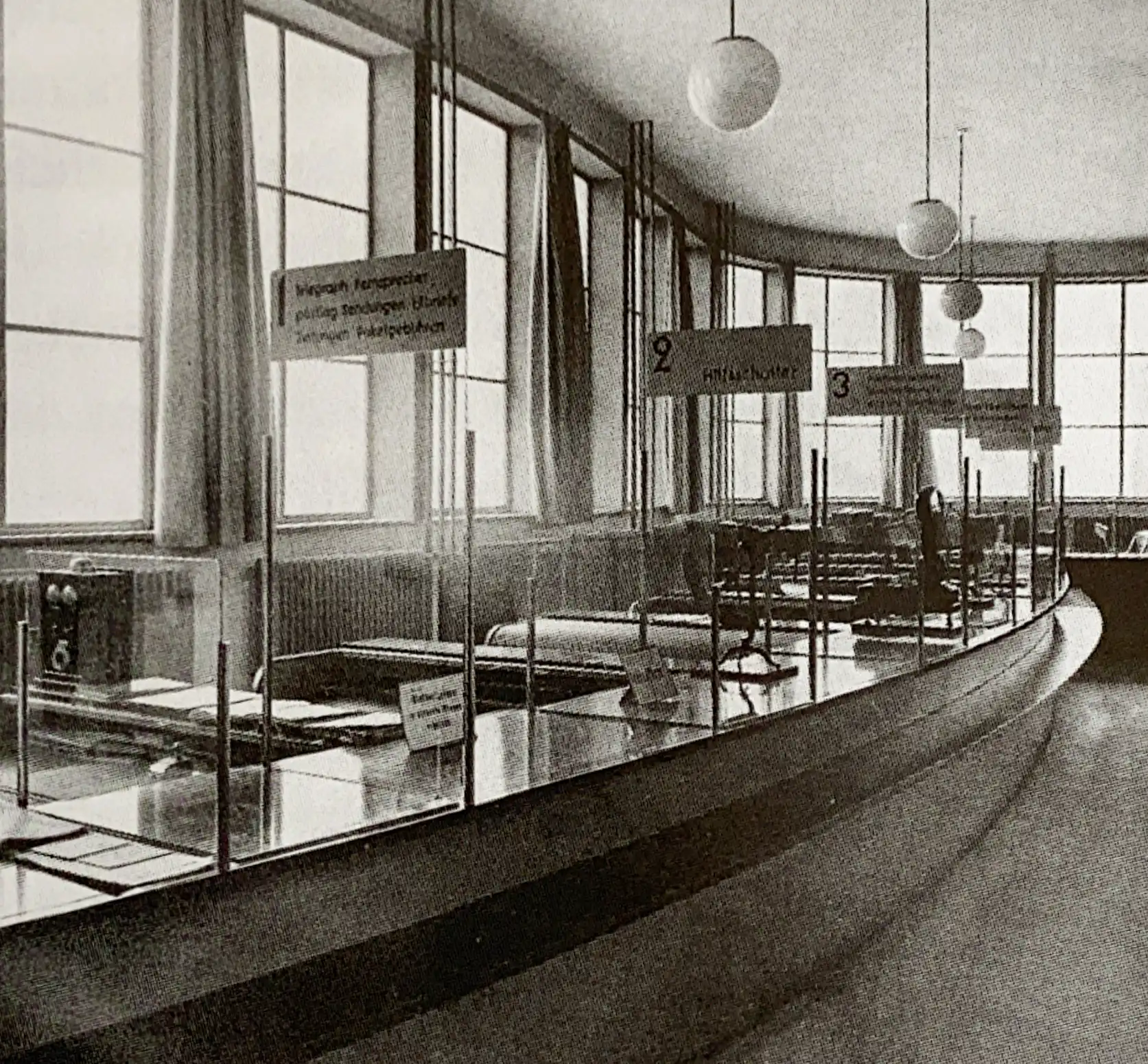
Postoffice Goetheplatz, 1931-1932. Architects: Franz Holzhammer, Walther Schmidt. Contemporary interior photo