
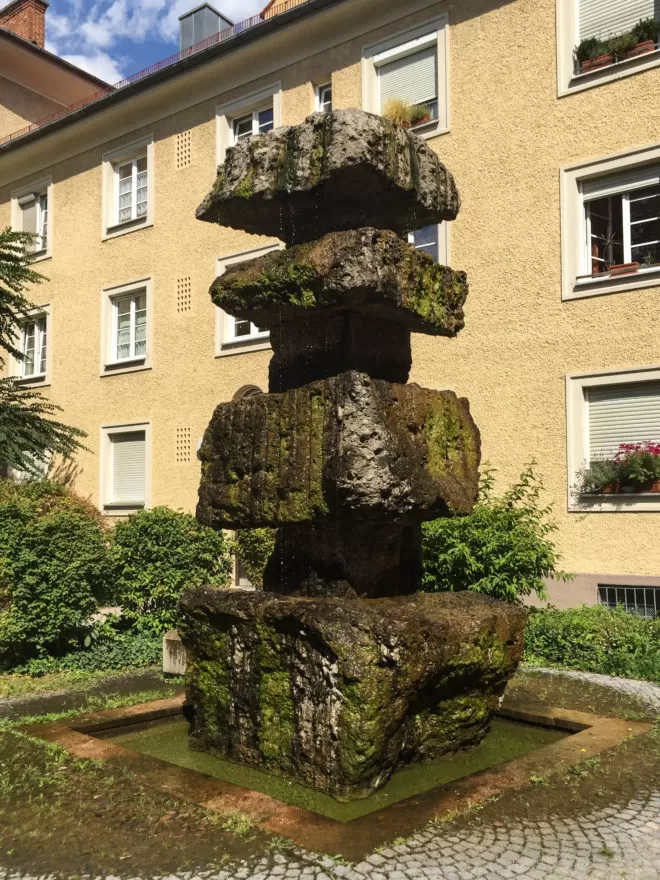
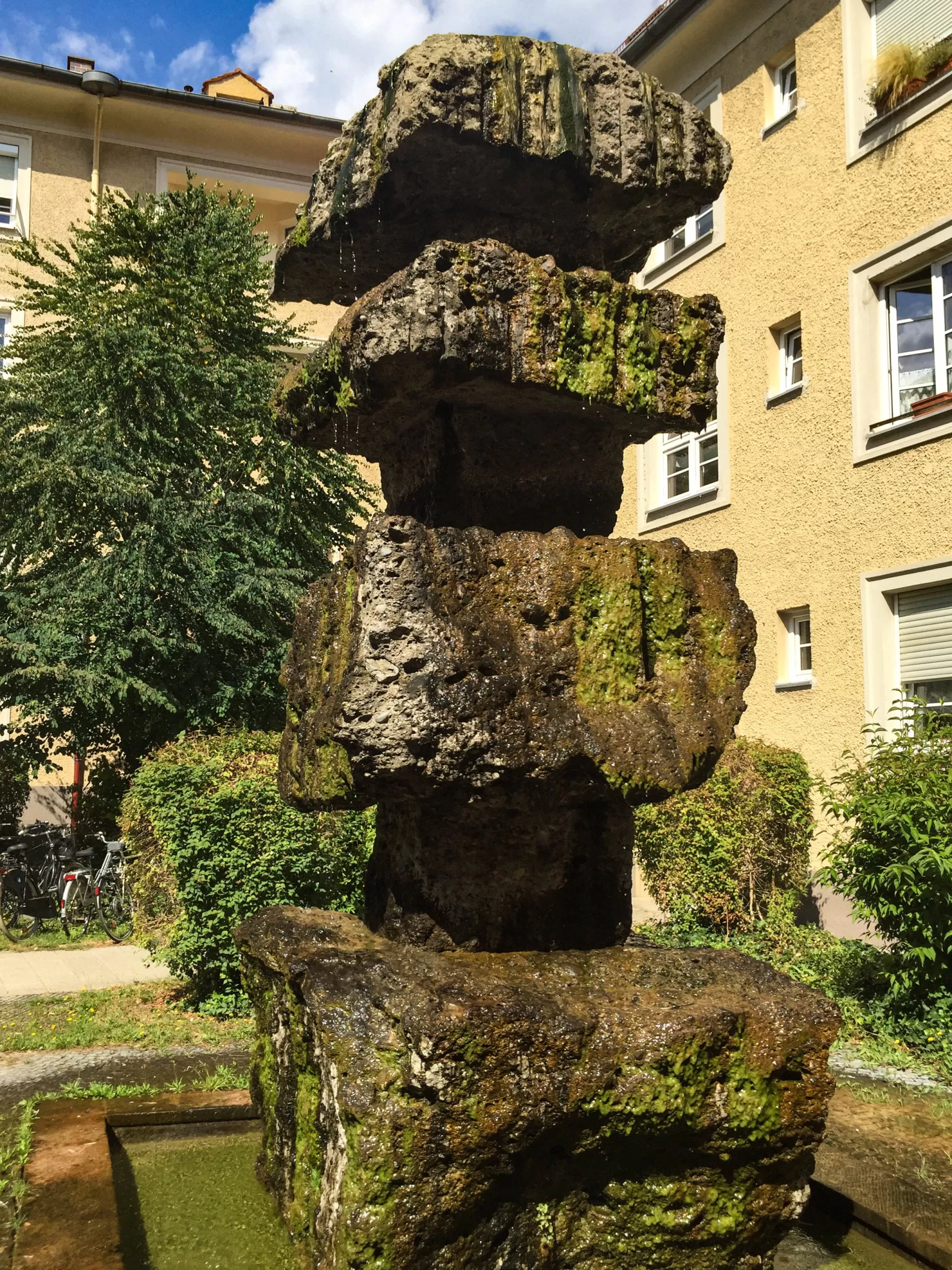
Der Steinerne Baum, 1928. Sculptor: Karl Knappe. Photo: Daniela Christmann
1928
Sculptor: Karl Knappe
Max-von-Gruber-Straße 3, Munich, Germany
Since 1928, the abstract sculpture Steinerner Baum (Max-von-Gruber-Brunnen), created by Karl Knappe, has stood on Max-von-Gruber-Strasse in Munich-Schwabing.
Karl Knappe
Knappe was born in Kempten, Allgäu, in 1884 and attended a grammar school in Bamberg until 1903. From 1904 to 1909, he studied at the School of Applied Arts and the Academy of Fine Arts in Munich.
From 1909 to 1911, he worked as a sculptor in Dresden and Berlin. In 1911, he received the Rome Prize.
From 1922 to 1928, he collaborated with Thomas Wechs on the Munich war memorial for those who died in World War I, which is now located in the Hofgarten.
In 1926, the State of Bavaria appointed him professor.
In 1930, he received a lectureship in sculpture from the Technical University of Munich.
The Nazi regime outlawed his sculptural activity in 1933 with a professional ban.
Hagar
The lost 1923 sculpture Hagar by Karl Knappe was found in 2010 during civil engineering work for a new subway line at the Berlin Sculpture Find in front of the Red City Hall in Berlin, along with ten other sculptures by different artists.
The sculpture had been confiscated by the National Socialists in the context of the Entartete Kunst (Degenerate Art) exhibition.
The finds were soon presented to the public in the Greek Courtyard of the Neues Museum on Berlin’s Museum Island.
In May 2013, a cast of Hagar was placed in Christophorus Church in Berlin-Siemensstadt.
Max-von-Gruber-Brunnen
The Steinerne Baum (Stone Tree), also known as the Max-von-Gruber-Brunnen, is a six-meter-high fountain sculpture made of Brannenburg Nagelfluh. It was built to commemorate the achievements of Max von Gruber, a senior medical councilor and professor of hygiene and bacteriology at Ludwig Maximilian University in Munich.
The sculpture was financed and commissioned by the Verein für Verbesserung der Wohnungsverhältnisse in München e.V. (Association for the Improvement of Housing Conditions in Munich).
Since the mid-1920s, Karl Knappe had created the reliefs for the war memorial in the Hofgarten, as well as the brick cuts on the Ledigenheim‘s façade, according to his designs.
In 1930, Knappe was appointed a professor of sculpture at the Technical University of Munich.
Despite strong protests from his students, he was removed from office in 1933 on charges of so-called cultural Bolshevism.
The fountain sculpture was also to be removed, but since the city did not own it, the proceedings were unsuccessful.
Der Steinerne Baum
The Stone Tree is located in a courtyard surrounded by residential buildings and sits in a square water basin.
A square, unpolished Nagelfluh stone supports a Nagelfluh trunk. Plates of different sizes symbolize the tree’s branches.
In a 1929 monograph on Karl Knappe, author Otto Fischer emphasizes the work’s affiliation with Cubism.
For Knappe, the water trickling over the sculpture and the resulting vegetation that slowly develops on the stones meant an expansion of the concept of sculpture in the direction of a temporal dimension.
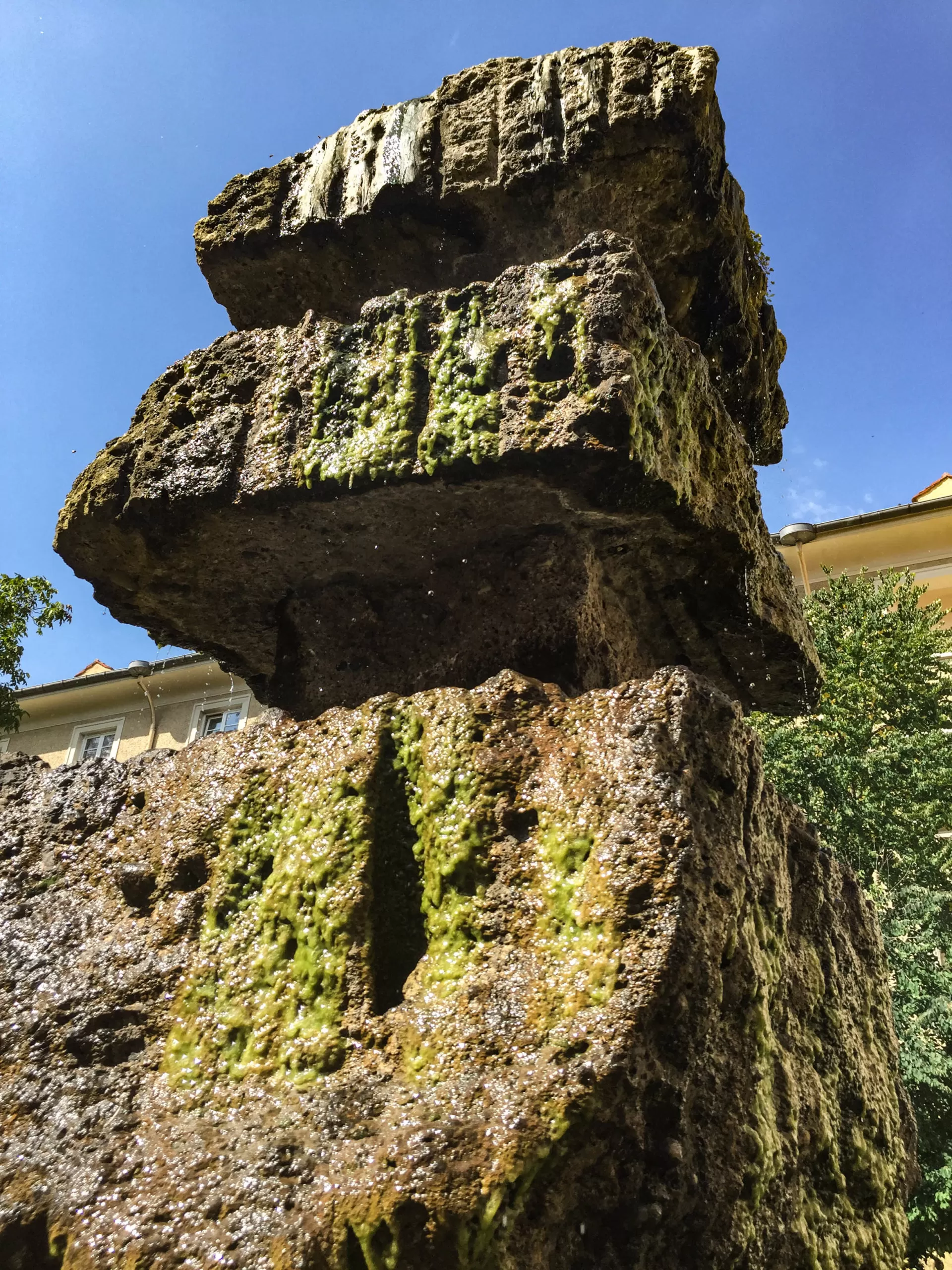
Der Steinerne Baum, 1928. Sculptor: Karl Knappe. Photo: Daniela Christmann
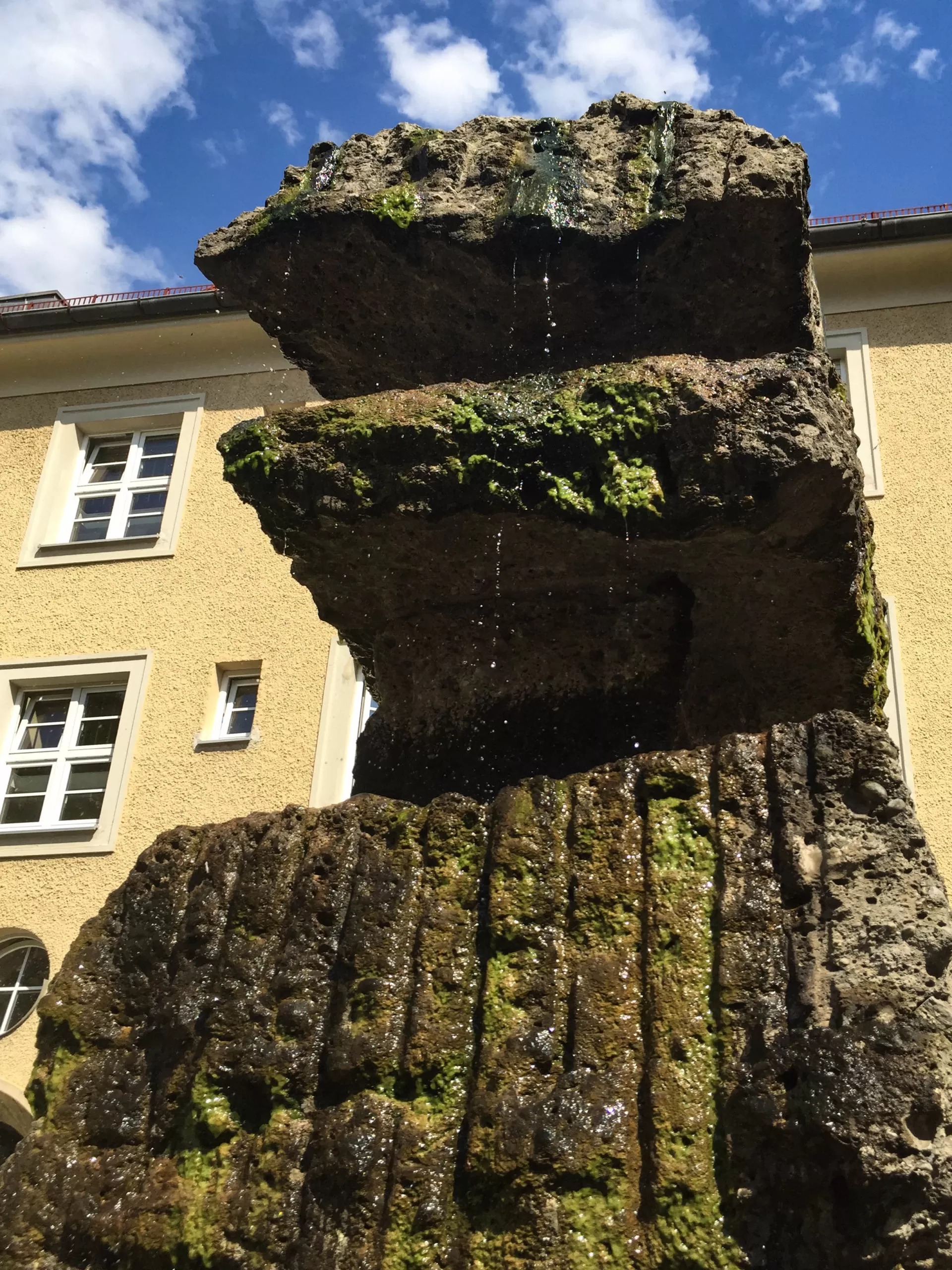
Der Steinerne Baum, 1928. Sculptor: Karl Knappe. Photo: Daniela Christmann